Six regular-season games were enough for Ken Dryden to earn a place in Montreal’s playoff plans. Two months later, he had won the Stanley Cup and the Conn Smythe Trophy. He was still eligible to be the NHL’s rookie of the year.
That unusual entrance set the pattern for a career that rarely followed the expected route. Dryden chose Cornell over an immediate push toward professional hockey, stepped away from the Canadiens to work in a law office, and retired at 31 with six championships. Books, broadcasting and Canadian politics would give him a public life well beyond the crease.
From suburban Toronto to Cornell
Kenneth Wayne Dryden was born in Hamilton, Ontario, on August 8, 1947, and grew up in the Toronto area. He played youth hockey with the Humber Valley Packers before joining the Etobicoke Indians at the Junior B level. His older brother, Dave, was also a goaltender and would play in both the NHL and WHA.
Boston selected him 14th overall in the third round of the 1964 NHL Amateur Draft, then traded his rights to Montreal that June. Dryden did not learn until years later that the Bruins had drafted him.
His next important move was to university, not an NHL training camp. At Cornell, he studied history and became the foundation of a powerful college team.
Across three varsity seasons from 1966 to 1969, he posted a 76-4-1 record, a 1.59 goals-against average and a .939 save percentage. Cornell won the 1967 NCAA championship and three consecutive ECAC tournament titles with him in goal. He earned All-American honors in each of those seasons and was named ECAC Player of the Year in 1969.
College gave him more than a route into professional hockey. It established a balance between sport and study that he would continue to protect, even when Montreal offered a much bigger stage.
Six games, then a Stanley Cup
After Cornell, Dryden pursued a law degree at McGill University while continuing his hockey career. He represented Canada at the 1969 World Championship and spent most of the 1970-71 season with the AHL’s Montreal Voyageurs.
His NHL debut came in March 1971. He won all six of his regular-season appearances, giving coach Al MacNeil enough confidence to start him in the playoffs.
The assignment was hardly gentle. Montreal opened against defending champion Boston, whose lineup included Bobby Orr and Phil Esposito. The Canadiens won the seven-game series, then eliminated Minnesota before beating Chicago in another seven-game contest to take the Cup.
Dryden received the Conn Smythe Trophy as playoff MVP. He had won hockey’s biggest team prize before losing an NHL regular-season game.
Because those six appearances did not exhaust his rookie eligibility, the Calder Memorial Trophy followed in 1972. He remains the only player to win the Conn Smythe before the Calder.
That first NHL spring also produced a family milestone. On March 20, 1971, Ken and Dave appeared in opposing goals when Montreal faced Buffalo-the only NHL game in which the brothers played against each other.
The Summit Series and a second championship
The 1972 Summit Series placed Dryden in a different kind of pressure. Sharing Canada’s goaltending duties with Tony Esposito, he faced a Soviet team whose speed, passing and preparation unsettled Canadian expectations.
He started four of the eight games, including the decisive final contest in Moscow. Canada won that game 6-5 on Paul Henderson’s late goal to claim the series.
The experience also connected his playing career with his growing interest in writing. Face-Off at the Summit, written with Mark Mulvoy, appeared in 1972.
Back in Montreal, the 1972-73 season brought another Stanley Cup, his first Vezina Trophy and his first NHL First All-Star Team selection. Within three NHL seasons, he had already collected two championships and the league’s major rookie and playoff awards.
Then he stopped playing.
A year in a law office
A contract dispute kept Dryden out for the entire 1973-74 season. Rather than wait at home for negotiations to move, he worked toward his legal qualification, articling at Toronto firm Osler, Hoskin & Harcourt.
His reported pay was $135 a week-a considerable change from the earning power of an established NHL goaltender.
The decision was consistent with the choices he had made before reaching Montreal. Hockey mattered, but it was not the only work he wanted to do. During the same season, he stayed close to the sport as a television commentator for the WHA’s Toronto Toros.
He returned to the Canadiens for 1974-75. Montreal lost to Buffalo in the semifinals, but the team was approaching the most successful stretch of his career.
Four straight Cups, then an early exit
From 1976 through 1979, Montreal won four consecutive Stanley Cups. Dryden supplied the goaltending behind a roster featuring Guy Lafleur, Larry Robinson, Serge Savard and Guy Lapointe.
He earned First All-Star Team recognition and a Vezina Trophy in each of those four seasons, finishing with five of each. The Vezina then recognized the eligible goaltenders on the team allowing the fewest goals, rather than being decided by the modern vote for the league’s best goalie. He shared his final three awards with Michel Larocque.
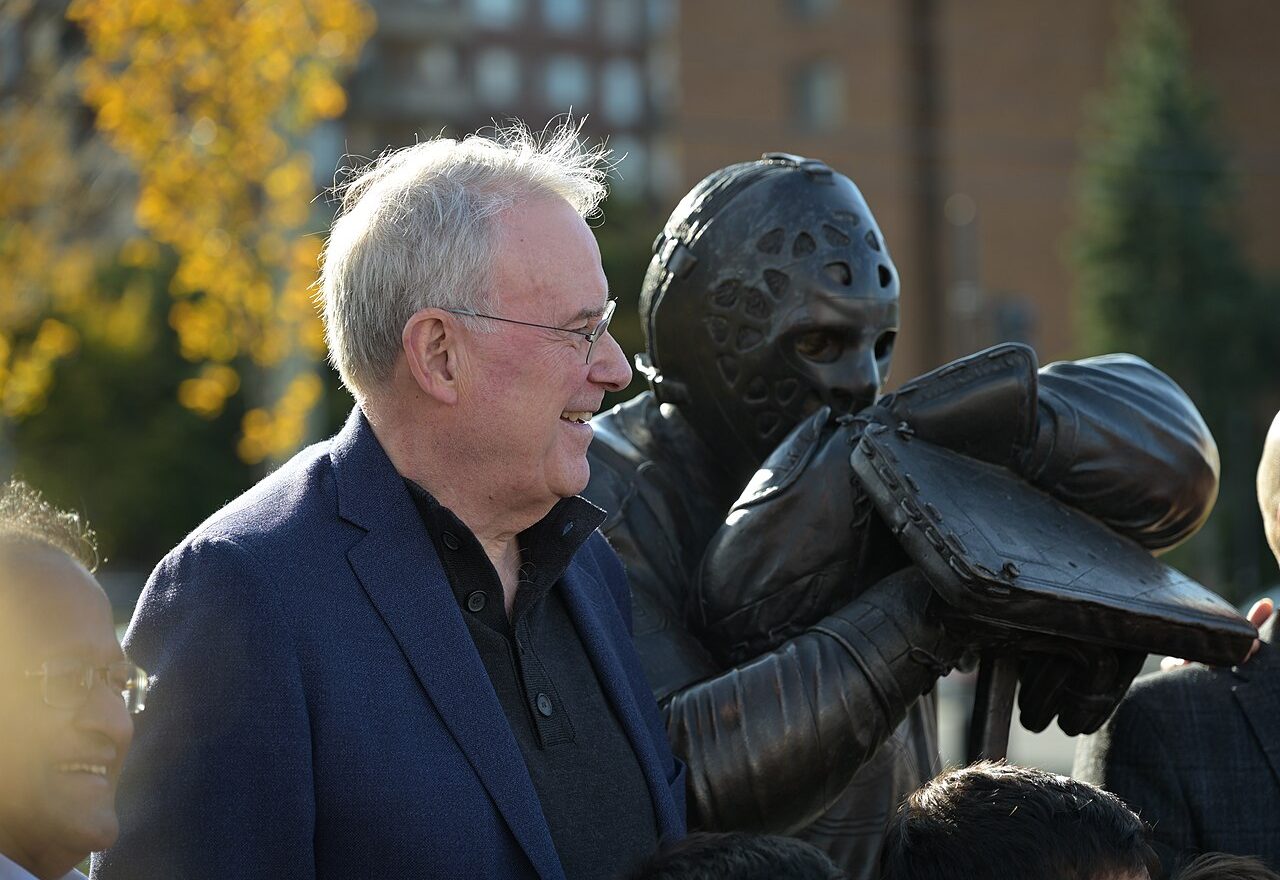
At 6 feet 4 inches, Dryden covered considerable net, but his game was not simply a matter of size. Positioning, anticipation and controlled movement helped him make difficult situations look less frantic. His familiar resting pose-leaning forward on his stick while play moved elsewhere-became an enduring hockey image.
He finished with 258 wins, 57 losses and 74 ties in 397 regular-season appearances, along with 46 shutouts, a 2.24 goals-against average and a .922 save percentage. In the playoffs, he went 80-32 across 112 games, recording 10 shutouts.
On July 9, 1979, he retired at 31. All eight of his NHL seasons, including that brief first campaign, had been spent with Montreal.
The Hockey Hall of Fame inducted him in 1983. The Canadiens retired his No. 29 in 2007; Cornell retired his No. 1 in 2010.
Finding another voice away from the rink
Retirement gave Dryden more time to examine the world he had just left. Published in 1983, The Game explored the Canadiens’ dressing room, the routines of a season and the uncertainty beneath an athlete’s public confidence. Rather than simply recounting victories, he wrote about teammates as people and hockey as a workplace.
His later books ranged beyond his own career. In School followed life inside Canadian classrooms, while Game Change examined Steve Montador’s life and the consequences of brain injuries in hockey. Scotty: A Hockey Life Like No Other, published in 2019, returned to the sport through coach Scotty Bowman.
Broadcasting offered another outlet. Dryden worked alongside Al Michaels on ABC’s coverage of the United States’ upset of the Soviet Union at the 1980 Olympics, the game remembered as the “Miracle on Ice.” He also worked subsequent Winter Olympics.
In 1997, he became president of the Toronto Maple Leafs, a notable change of allegiance for someone whose entire NHL playing career belonged to Montreal. He held that position until 2003.
Family and public service
Dryden and his wife, Lynda, had two children, Sarah and Michael, and four grandchildren. His daughter-in-law, Tammy Lee Shewchuk, won Olympic hockey gold with Canada in 2002.
His interest in public affairs predated retirement: he worked with Ralph Nader’s Public Citizen organization during the summer of 1971. Decades later, he entered elected politics.
Representing York Centre as a Liberal, he served in Canada’s House of Commons from 2004 to 2011 and was minister of social development from 2004 to 2006. His work outside government also included scholarships supporting postsecondary education for young people who had been in care.
Dryden died in Toronto on September 5, 2025, aged 78. His playing career had been short by NHL standards; the work that followed occupied more than four decades.
FAQ
How many Stanley Cups did Ken Dryden win?
He won six with Montreal: in 1971, 1973, 1976, 1977, 1978 and 1979.
Why did he win playoff MVP before rookie of the year?
He played only six regular-season games before the 1971 playoffs, so he remained eligible for the Calder Trophy the following season.
Why did he miss the 1973-74 season?
A contract dispute led him to sit out. He spent the season articling at a Toronto law firm and broadcasting Toronto Toros games.
Did he play for the Boston Bruins?
No. Boston drafted him in 1964 but traded his rights to Montreal before he played professionally.
What is his best-known book?
The Game, published in 1983, is his best-known book. It examines professional hockey through his experiences with the Canadiens.
Photo: Pierre5018, CC BY 4.0, via Wikimedia Commons