Forty-four wins, a 1.96 goals-against average, a .933 save percentage, nine shutouts. Carey Price’s 2014-15 season still reads like a goaltending clinic written in numbers.
For Montreal, though, the story was bigger than one brilliant year. Price spent his entire NHL career with the Canadiens, became the winningest goalie in franchise history with 361 victories, and built a résumé that stretched from a standout junior run to Olympic gold and the Hockey Hall of Fame. Calm almost to the point of stillness, he was the kind of goaltender who could make a difficult game look strangely orderly.
From Anahim Lake to major junior
Carey Price was born on August 16, 1987, in Vancouver, British Columbia, but his hockey story really begins in Anahim Lake, a remote community in central British Columbia where he was raised. The setting mattered. This was not the usual big-city development track, and the travel alone said something about the effort behind his rise.
His father, Jerry Price, had played professional hockey as a goaltender, and his mother, Lynda Price, went on to become the first woman elected as a regional chief of the British Columbia Assembly of First Nations. Hockey and community leadership were both part of the household. Price also grew up with his sister, Kayla.
He learned to skate as a small child on a creek near the family property. Reaching games and practices often meant long distances, and his father, who was a pilot, sometimes flew him to hockey commitments. It is one of those details that helps explain the discipline around his early development without turning the story into myth.
Price played minor hockey in Williams Lake and later suited up for the Williams Lake Midget AAA Timberwolves, helping that team win a provincial title. From there, he moved into the WHL with the Tri-City Americans, where he played from 2002-03 through 2006-07 and steadily turned into one of the top goaltending prospects in junior hockey.
By his final WHL season, the profile was clear. He won the Del Wilson Trophy as the league’s top goaltender and was named CHL Goaltender of the Year. Then he finished his junior career with one more emphatic run: in 2007, he backstopped Tri-City to the WHL final and was named playoff MVP with the Four Broncos Memorial Trophy.
Drafted early, promoted quickly
The Montreal Canadiens selected Price with the fifth overall pick in the 2005 NHL Draft, a high slot for a goaltender and a sign of how strongly the organization believed in him.
He did not jump straight into a long NHL stay. After returning to junior following the draft, he turned pro in 2007 and joined the Hamilton Bulldogs of the AHL. That spring became an important bridge between prospect status and NHL expectations. Price helped Hamilton win the Calder Cup and was named the most valuable player of the playoffs, taking home the Jack A. Butterfield Trophy.
By the fall, he was in Montreal. Price made his NHL debut in 2007-08 and quickly showed enough poise to earn a place on the NHL All-Rookie Team. The Canadiens had invested heavily in him, and the early return suggested they had found their next franchise goaltender.
The long Montreal run
Price played 15 NHL seasons with the Canadiens, from 2007-08 to 2021-22, and never wore another NHL sweater in a game. In an era of constant roster churn, that gave his career a certain shape: one city, one crease, one standard to meet year after year.
His regular-season totals underline both quality and workload. In 712 games, he went 361-261-79, posted a 2.51 goals-against average, a .917 save percentage, and 49 shutouts. The 361 wins remain the most by a goaltender in Canadiens history.
There were strong seasons before his peak and meaningful ones after it, but 2014-15 stands apart. Price led the NHL in wins, goals-against average, and save percentage, and tied for the league lead in shutouts. He won the Hart Trophy as league MVP, the Vezina Trophy as the top goaltender, the Ted Lindsay Award as the most outstanding player as voted by the NHLPA, and the William M. Jennings Trophy, shared with Corey Crawford, for allowing the fewest goals.
That combination was historic. No goaltender before him had won the Hart, Vezina, Ted Lindsay, and Jennings in the same season.
He was also a frequent All-Star selection, chosen for the NHL All-Star Game seven times: 2009, 2011, 2012, 2015, 2017, 2018, and 2019. Those appearances reflected how consistently he sat near the top of the position during his best years.
The postseason brought some of his most memorable work, even without a Stanley Cup title at the end of it. In 2014, Montreal reached the Eastern Conference Final before Price was injured in the series against the New York Rangers. In 2021, with the Canadiens entering the playoffs as an underdog, he delivered another reminder of his big-game reputation and led the club to the Stanley Cup Final. Tampa Bay won that series, leaving Price without the one team honor missing from his NHL résumé.
Injuries, absence, and the end of his playing career
The closing chapter of Price’s career was shaped by health more than performance. He dealt with significant knee issues late in his time with Montreal, and after appearing in only five games in 2021-22, he did not play in the NHL again.
In October 2021, Price entered the NHL/NHLPA Player Assistance Program. He later said he had entered the program for substance use. That part of his story should be handled plainly and carefully: it was public, confirmed by Price himself, and part of the difficult final stretch of his career.
His contract situation also became part of the conversation. Price had signed an eight-year, $84 million extension with Montreal that began in 2018-19. Although his playing career effectively ended before that deal ran its course, the contract remained on the books. In a later paper transaction, his contract was traded to the San Jose Sharks, but he did not play for the organization.
Price was inducted into the Hockey Hall of Fame in 2026, a formal recognition of a career that had long since met that standard.
Canada trusted him on the biggest stage
Long before he became Canada’s starting goalie at the Olympics, Price had already built a strong international record.
He won silver with Canada Pacific at the 2004 World U-17 Hockey Challenge. He also won gold at the 2004 U18 Junior World Cup and silver at the 2005 IIHF World U18 Championship. In 2007, he added a gold medal at the World Junior Championship as part of Canada’s title-winning team.
The most famous international chapter came in Sochi. At the 2014 Winter Olympics, Price was Canada’s starter and delivered a nearly flawless tournament, finishing with a 0.59 goals-against average and a .972 save percentage. He was named the tournament’s best goaltender as Canada won gold.
Two years later, he was part of another championship run, helping Canada win the 2016 World Cup of Hockey. For a player already known for composure, those tournaments only reinforced the image: when the games tightened, Canada trusted him.
Why his game worked
Price played a butterfly style, and Patrick Roy was one of his early influences, but the defining quality of his game was not acrobatics. It was control.
At his best, he looked economical. His angle play was clean, his movements were compact, and rebounds rarely turned into chaos. Teammates and opponents alike often described the same thing in different words: he made difficult saves look routine because he was so often in the right place before the shot arrived.
That style is a big reason his best seasons aged well in memory. The numbers were elite, but so was the feel of watching him. There was very little wasted motion. In a loud market like Montreal, that calm became part of his identity.
Life away from the rink
Off the ice, Price’s roots remained central to his public life. Raised in Anahim Lake and proudly connected to his Ulkatcho First Nation heritage, he has been visible in work involving Indigenous and northern communities. He has supported breakfast programs and youth initiatives, including efforts tied to Breakfast Club of Canada.
That part of his profile never felt separate from the hockey story. His upbringing was remote, travel-heavy, and different from the standard path through the sport, so it made sense that he often spoke about representation, pride in heritage, and opportunity for young people coming from similar communities.
Price married Angela Webber in 2013, and the couple have children together. That much is public and well established. He is also related to longtime NHL captain Shane Doan; they are cousins.
As for the final hints about retirement before it became official, those should stay in the category of reported comments rather than hard fact. Various outlets reported that Angela Price alluded to the end of his playing career, and Sportsnet reported that Price said he did not expect to play again. Given his knee issues and long absence, those reports fit the broader reality, but they are best described as reported remarks, not dramatic revelations.
The Carey Price legacy
For the Canadiens, the headline number is 361 wins. For the wider hockey world, it may be that 2014-15 trophy sweep, one of the clearest examples of a goaltender dominating an NHL season from start to finish.
But the full picture is broader than either of those markers. Carey Price was a first-round pick who met the pressure in Montreal, an Olympic gold medalist, a World Cup winner, a franchise-record holder, and for long stretches the standard by which other NHL goaltenders were measured. He did it with technical precision, unusual calm, and a career arc that stayed tied to one of hockey’s most demanding markets from beginning to end.
FAQ
Is Carey Price retired?
Yes. He has not played since 2022, and his Hall of Fame induction confirmed the close of his playing career.
When was Carey Price drafted?
The Montreal Canadiens selected him fifth overall in the 2005 NHL Draft.
How many wins did Carey Price finish with?
He finished his NHL career with 361 regular-season wins.
Did Carey Price win a Stanley Cup?
No. He reached the Stanley Cup Final with Montreal in 2021, but the Canadiens did not win the championship.
What major awards did Carey Price win?
His biggest NHL awards were the Hart Trophy, Vezina Trophy, Ted Lindsay Award, and William M. Jennings Trophy, all from the 2014-15 season.
What teams did Carey Price play for?
In NHL games, he played only for the Montreal Canadiens. He also played junior hockey for the Tri-City Americans and AHL hockey for the Hamilton Bulldogs.
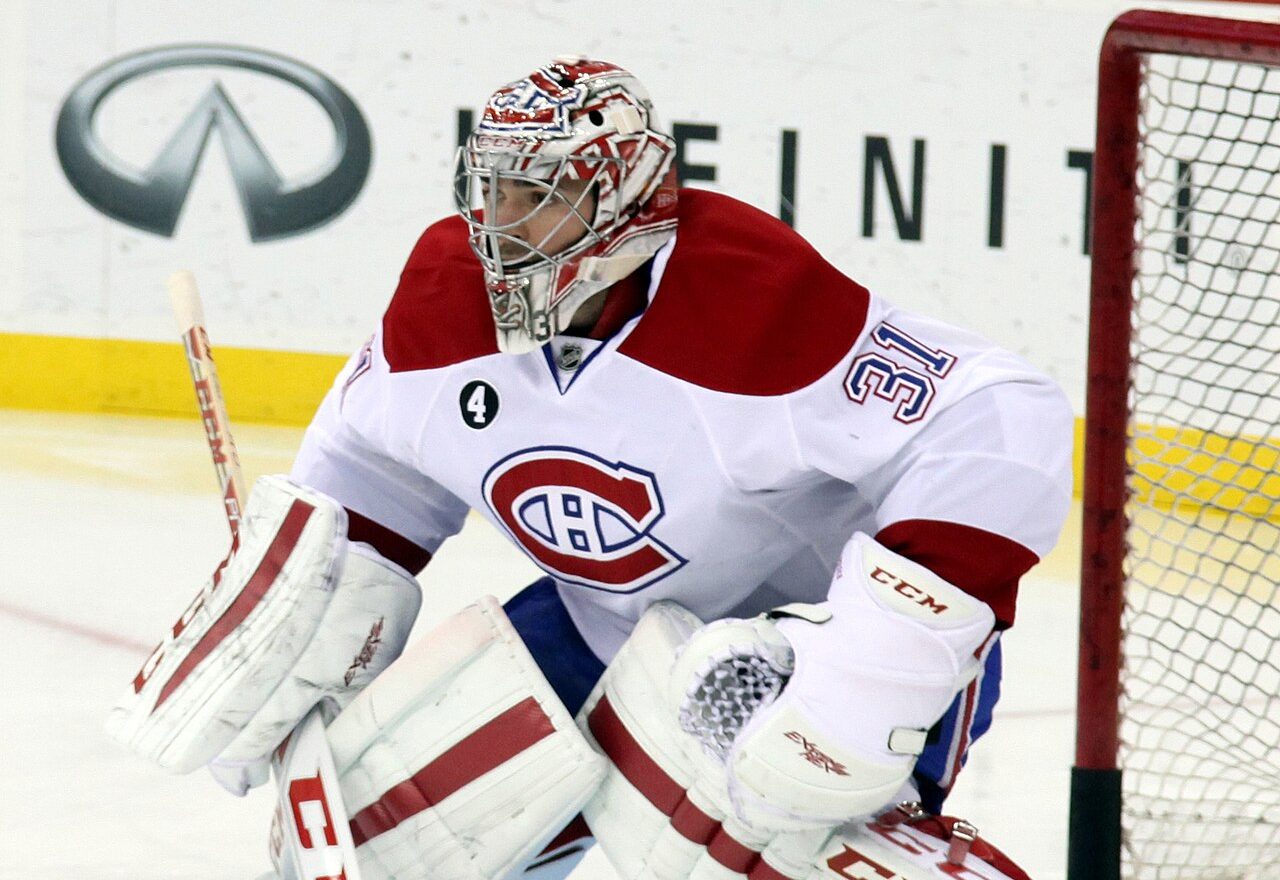
Photo: Lisa Gansky from New York, NY, USA, CC BY-SA 2.0, via Wikimedia Commons