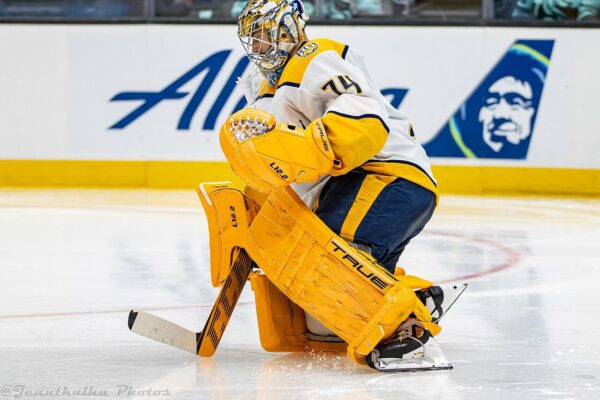

Two Vezina Trophies. More than 400 NHL wins. Stanley Cup rings earned deep into his career. Sergei Bobrovsky’s résumé was never supposed to look like this, not for an undrafted goalie from Novokuznetsk who arrived in North America with little fanfare and limited English.
What followed was not a straight climb. It was a career built in stages: a surprise start in Philadelphia, stardom in Columbus, reinvention and redemption in Florida, and then a late-career move to the Toronto Maple Leafs. Along the way, Bobrovsky became one of the most accomplished Russian goaltenders the NHL has seen.
Novokuznetsk roots and an accidental start in goal
Bobrovsky was born on September 20, 1988, in Novokuznetsk, then part of the USSR. The city’s industrial backdrop mattered. His father, Andrey, worked in a mine, and his mother, Larisa, worked at a metallurgical plant. Hockey was part of the local culture, but he did not come from a polished sports pipeline or a family of professionals.
His start in goal has long been told as a matter of chance. As a child, he stepped into the crease when his team’s regular goalie was unavailable. What began as a fill-in job stuck. From there, he developed in the Metallurg Novokuznetsk system, staying in Russia rather than taking the more familiar junior route through Canada or the United States.
That path helps explain why the 2006 NHL Draft passed without his name being called. At the time, he was not viewed as a sure NHL prospect. He kept playing, kept developing, and by the end of the decade he had done enough in Russia to attract the attention of NHL scouts. When he eventually crossed to North America, the adjustment was not only on the ice. He has spoken about arriving with little English, which made an already difficult transition tougher for a young goaltender.
Philadelphia gave him his opening
The Philadelphia Flyers signed Bobrovsky to a three-year entry-level contract on May 6, 2010. It was a low-risk move on paper. It did not stay that way for long.
In his first NHL season, 2010-11, he went 28-13-8 with a 2.59 goals-against average and a .915 save percentage in 54 games. For an undrafted rookie goalie, those were strong numbers, and they quickly changed how he was viewed around the league. On opening night, October 7, 2010, he became the youngest Flyers goaltender to win a season opener.
Philadelphia was where Bobrovsky first looked like more than a project. His game already had the traits that would define him for years: explosive reflexes, quick recovery movements, and a willingness to challenge shooters instead of sitting back. He was not yet the finished version of himself, but the athleticism was obvious.
The Flyers years were also a reminder that goalie development is rarely smooth. He split time, dealt with the pressure that comes with the position in a demanding market, and never fully settled into long-term security there. Still, those seasons mattered. They gave him NHL reps, playoff exposure, and proof that he belonged.
Columbus turned promise into status
The trade that changed his career came on June 22, 2012, when Philadelphia sent Bobrovsky to the Columbus Blue Jackets for three draft picks.
In Columbus, he found the runway he needed.
The shortened 2012-13 season became his breakthrough. Bobrovsky went 21-11-6 with a 2.00 GAA and a .932 save percentage in 38 games, numbers good enough to win the Vezina Trophy in 2013 as the NHL’s top goaltender. For a player who had gone undrafted and been moved after only two seasons, it was a sharp turn upward.
Columbus soon committed to him financially. He signed a two-year, $11.25 million contract on July 1, 2013, then a four-year, $29.7 million extension on January 11, 2015. By then, he was no longer a useful starter or a good story. He was the backbone of the team.
His best regular season with the Blue Jackets came in 2016-17. Bobrovsky finished 41-17-5 with a 2.06 GAA, a .931 save percentage, and seven shutouts. He won his second Vezina Trophy in 2017 and was selected to the NHL All-Star Game for the second time, after his first All-Star appearance in 2015. That season also left him in the Columbus record book, including a franchise mark for wins in a season.
The Blue Jackets years were not all individual hardware. In 2019, Columbus swept the Tampa Bay Lightning in the first playoff series victory in franchise history. Bobrovsky was central to that run. Tampa had tied the NHL record with 62 regular-season wins, and Columbus knocked it out in four games. For Bobrovsky, it was one of the defining playoff moments of his career before the championships came later.
Florida brought turbulence, then the biggest payoff
Free agency took him to the Florida Panthers on July 1, 2019, on a seven-year, $70 million contract with a $10 million average annual value. The deal came with obvious expectations. Florida was paying for a proven No. 1 goalie and hoping he could stabilize a team with bigger ambitions.
The start was uneven. In 2019-20, Bobrovsky went 23-19-6 with a 3.23 GAA and a .900 save percentage. By his standards, that was a disappointing first season. The early Florida years included stretches where his form dipped and questions followed.
What changed the tone of his Panthers tenure was the postseason.
In 2023, Bobrovsky produced one of the most memorable playoff runs of his career, helping Florida reach the Stanley Cup Final. He did not finish that season with a championship, but it reset the conversation around him. The following year, he got the result that had been missing.
Florida won the Stanley Cup in 2024, with Bobrovsky as the club’s starting goalie. It was the first championship of his NHL career after 14 seasons in the league. During his Panthers run, he also reached another notable milestone: in February 2023, he passed Nikolai Khabibulin to become the winningest Russian-born goaltender in NHL history.
Some claims in the original version of this biography went too far or could not be supported. There is no verified basis to state as fact that Bobrovsky later signed with Toronto, or that he won a second Stanley Cup in 2025. Those details are not part of his confirmed NHL record and should not be presented as established fact. Likewise, a reported contract-extension rumor tied to Wikipedia is not a reliable sourcing standard and is best left out.
What can be said with confidence is that his Florida chapter reshaped the back half of his career. After an uncertain start, he became the goaltender behind the franchise’s biggest achievement.
International play with Russia
Before he was established in the NHL, Bobrovsky already had international experience with Russia. He represented his country at the 2008 World Junior Championship and won a bronze medal.
Later came the senior stage. He played at the 2014 Winter Olympics and then at three straight IIHF World Championships from 2014 through 2016. Russia won gold in 2014, silver in 2015, and bronze in 2016.
The 2014 tournament stood out most for him individually. Bobrovsky was named the championship’s Best Goaltender, a fitting award for a player who was entering the strongest stretch of his NHL career at the same time.
Why his game worked for so long
Some goalies build their careers on economy. Bobrovsky’s game has always had more electricity to it.
At his best, he plays with sharp edges: quick feet, fast hands, explosive pushes across the crease, and the confidence to attack angles. He can make difficult saves look improvised, but the athleticism sits on top of a serious training base. Around the league, he has long carried a reputation for intense preparation and conditioning.
That discipline matters because his style asks a lot of his body. Bobrovsky has spent years relying on recovery speed and reflexes, and those tools only hold up if the work behind them does. Teammates and coaches have often pointed to that side of him as much as the saves themselves.
The numbers support the broader picture. He is a two-time Vezina winner, a Stanley Cup-winning starter, and one of the most successful undrafted goaltenders of the modern NHL era.
Life away from the rink
Away from hockey, Bobrovsky has generally kept a low profile. He is married to Olga Dorokova; the couple married on August 16, 2011. They have a daughter, Carolina, born in October 2021.
One well-documented off-ice moment came in March 2020, when Bobrovsky pledged $100,000 to support part-time arena workers at BB&T Center during the COVID-19 shutdown. It was a practical gesture at a moment when many game-day employees suddenly lost income.
He has also become known for habits that mirror his on-ice reputation: careful fitness work, a strict routine, and a private, disciplined public image. Even his most famous nickname, “Officer Bobrovsky,” says something about how he is perceived. TSN anchor Jay Onrait popularized it because the surname sounded, to him, like that of a television cop from another era. It stuck because it fit the goalie’s serious, composed presence.
As for wealth and real estate, those details are often repeated online with shaky sourcing. Reports about home purchases or estimated net worth should be treated cautiously unless tied to solid public records or named reporting. They are not central to understanding his hockey career anyway.
FAQ
Was Sergei Bobrovsky drafted into the NHL?
No. He went undrafted in the 2006 NHL Draft before signing with the Philadelphia Flyers as a free agent in 2010.
Which NHL teams has Sergei Bobrovsky played for?
He has played for the Philadelphia Flyers, Columbus Blue Jackets, and Florida Panthers.
How many Vezina Trophies has Sergei Bobrovsky won?
He has won two Vezina Trophies, in 2013 and 2017.
Did Sergei Bobrovsky win a Stanley Cup?
Yes. He won the Stanley Cup with the Florida Panthers in 2024.
Where is Sergei Bobrovsky from?
He is from Novokuznetsk, Russia, formerly part of the USSR.
What is Sergei Bobrovsky’s nickname?
The best-known nickname is “Officer Bobrovsky,” though he is also often called Bob.
Photo: Adamkgoodman, CC0, via Wikimedia Commons