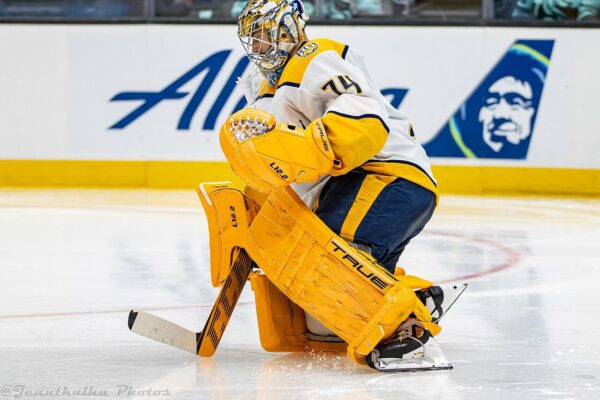

Two shutouts to finish two separate Stanley Cup Finals tells you plenty before the numbers even start. Andrei Vasilevskiy built his reputation in Tampa not just on talent, but on timing: the biggest saves often came when the stakes were highest.
From Tyumen to Ufa
Vasilevskiy was born on July 25, 1994, in Tyumen, Russia, into a hockey family that already knew the position well. His father, Andrei Sr., was a goaltender and later a coach, including work with Russia’s deaf national team. His older brother, Alexei, also played. For a while, the future NHL starter skated out as a forward, but goaltending became the obvious lane.
His development accelerated in the Salavat Yulaev Ufa system, one of Russia’s better-known pipelines. He played for the club’s youth teams and then for Tolpar Ufa in the MHL from 2010 through 2013. In 2011, Salavat Yulaev selected him seventh overall in the KHL Junior Draft, another sign that he was already viewed as a premium prospect.
The climb was quick. Vasilevskiy made his KHL debut as a teenager and, by the time the 2012 NHL Draft arrived, he was widely regarded as the top goaltender in the class. Tampa Bay took him 19th overall, making him the first goalie selected that year.
One draft story has lasted because it fits the player’s public image. During an interview with the Lightning, he was reportedly drawing, calm enough to doodle in the middle of one of the biggest days of his career. Whether that moment has grown in the retelling or not, it matches the version of Vasilevskiy the hockey world came to know: composed, self-contained, rarely rushed.
KHL seasoning before the NHL
Before heading to North America, he spent parts of four seasons with Salavat Yulaev Ufa. Across regular-season KHL play, he appeared in 54 games from 2010-11 through 2013-14. His strongest stretch came in the 2013-14 playoffs, when he posted a .934 save percentage and a goals-against average under 2.00 in a brief but impressive run.
Tampa Bay signed him to a three-year entry-level contract on May 6, 2014. The deal carried a $925,000 NHL cap hit, but the more important detail was developmental: the Lightning did not force the timeline. They let him adjust.
That first North American season began with the Syracuse Crunch in the AHL. In 2014-15, he played 23 regular-season games there and went 14-6-5 with a .918 save percentage and two shutouts. For a young Russian goalie adapting to smaller ice, heavier traffic and a different schedule, it was a strong opening step.
Breaking in with the Lightning
His NHL debut came on December 16, 2014, against the Philadelphia Flyers. He won. A few months later, on March 3, 2015, he recorded his first NHL shutout in a 4-0 win over the Carolina Hurricanes.
Even then, the outline of his game was easy to spot. Vasilevskiy had the size teams covet in a modern starter at 6-foot-3 and well over 220 pounds, but his game never depended on bulk alone. He moved quickly laterally, recovered fast, and stayed calm through broken plays. That combination made him more than a big goalie who blocked space. He could erase second chances and survive scrambles.
For a while, he worked behind Ben Bishop. That apprenticeship mattered. Tampa had a contender, and Vasilevskiy did not have to carry the crease immediately. Instead, he learned inside a winning environment under coach Jon Cooper, then gradually took over the net.
The Lightning reinforced that plan with a three-year contract extension on July 1, 2016, worth $10.5 million. By then, the organization had made its choice. Vasilevskiy was the future starter.
Becoming Tampa Bay’s backbone
Once the crease became his, the volume followed. So did the wins.
In 2017-18, he set franchise records with 44 wins and eight shutouts in a season. He also put together a nine-game winning streak, another Tampa Bay mark at the time. From 2017-18 through 2021-22, he led the NHL in wins five straight seasons, a run that said as much about durability as excellence.
The awards soon caught up. He won the Vezina Trophy in 2018-19 as the league’s top goaltender and was named to the NHL First All-Star Team that season. He also became a regular at All-Star Weekend.
On July 29, 2019, the Lightning committed to him for the long haul with an eight-year, $76 million extension carrying a $9.5 million cap hit. It was the kind of contract reserved for franchise pillars, and by then he clearly was one.
He also stood out in smaller ways. Vasilevskiy wears No. 88, an unusual choice for a goaltender, and became the first goalie in NHL history to wear that number.
The Cup runs that defined him
Regular-season success made him elite. The playoffs made him unmistakable.
Tampa Bay won the Stanley Cup in 2020 and again in 2021, with Vasilevskiy as the starting goaltender both times. During the 2020 postseason, he set NHL records for most wins in a single playoff year with 18 and most minutes played in one postseason at 1,708:12.
Then came the run of clinchers, the stretch that turned his playoff résumé into something more specific and memorable. Vasilevskiy recorded a shutout in the series-clinching game of the 2020 Stanley Cup Final against Dallas. He did it again to close the 2021 semifinal against the Islanders, then again in Game 5 of the 2021 Final against Montreal. He added another series-clinching shutout in the 2022 first round against Toronto.
At one point, he posted five consecutive series-clinching shutouts, tying an NHL record. He also set the league mark for most shutouts in series-clinching wins, a niche statistic perhaps, but one that captures his reputation perfectly: when Tampa had a chance to finish a series, he often slammed the door.
The 2021 playoffs brought him the Conn Smythe Trophy as postseason MVP. That award felt less like a surprise than a formal acknowledgment of what everyone had watched. If opponents wanted to beat the Lightning in that era, they usually had to solve Vasilevskiy first.
Setbacks, milestones and where the numbers stand
His career has not been a straight climb without interruption. Before the 2023-24 season, Vasilevskiy underwent back surgery and missed the opening stretch of the year. For any goaltender, especially one known for flexibility and explosive movement, that was a significant test.
He returned, and the larger body of work kept growing. On November 14, 2024, he became the fastest goaltender in NHL history to reach 300 wins, getting there in 490 games. Later that season, he played his 500th NHL game, the first goalie in Lightning history to reach that milestone.
He also owns the franchise record for saves in a game with 54.
Some of the totals in circulation around Vasilevskiy can vary depending on when they were published, and a few summaries mix regular-season and overtime-loss formats from different eras. What does not change is the shape of the career: hundreds of starts, well over 300 wins, a save percentage that has consistently sat in top-tier territory, and a place near the top of both Tampa Bay and NHL playoff record books.
One note of caution on later-career honors: Vasilevskiy won the Vezina in 2018-19. Claims of a second Vezina in 2025-26 are not part of the established NHL award record and should be treated as incorrect unless tied to a clearly identified alternate source.
Russia on the international stage
His international career has been strong at both junior and senior level.
Vasilevskiy won silver with Russia at the 2012 IIHF World U18 Championship and bronze at the 2013 World Junior Championship. He returned for the 2014 World Juniors before moving fully into senior competition.
At the IIHF World Championship, he helped Russia win gold in 2014 and later added bronze medals in 2017 and 2019. In both 2017 and 2019, he was named the tournament’s best goaltender and earned a spot on the All-Star Team.
He also received the Order of Honour from Russia following the 2014 world title. Earlier in his career, he won the Alexei Cherepanov Award as the KHL’s top rookie.
How Andrei Vasilevskiy plays
At his best, Vasilevskiy combines reach, balance and recovery speed in a way few goalies can. He covers the lower part of the net well, tracks pucks through traffic, and still has the athleticism to make desperation saves when structure breaks down.
What separates him from many big goaltenders is how little his movement looks forced. He can play deep or challenge, depending on the sequence, and he has long handled heavy workloads without obvious drop-off. That helped make him one of the defining starters of his generation.
Comparisons to great Russian goaltenders are inevitable. They are also best handled carefully. Vasilevskiy’s résumé is strong enough on its own without stretching into grand claims. Two Stanley Cups, a Conn Smythe, a Vezina, franchise records, and a long run as Tampa Bay’s No. 1 already place him in rare company.
Off the ice
The family influence is central to his story, and it remains the cleanest way to understand the person behind the mask. He grew up in a household shaped by the position, by training, and by the rhythms of hockey life.
Vasilevskiy is married, and he and his wife have a son. Beyond that, much of his private life has stayed just that: private. He has often been described as quiet and home-oriented, and reports over the years have linked him to low-key interests such as video games. Those details fit his public demeanor, though he has never tried to build a larger celebrity persona around them.
That reserve is part of why the occasional flash of emotion stands out. But in public, he has generally remained what he appeared to be as a prospect: calm, controlled, and more comfortable letting the performance speak for him.
FAQ
How old is Andrei Vasilevskiy?
He was born on July 25, 1994.
What team does Andrei Vasilevskiy play for?
He plays for the Tampa Bay Lightning.
When was Andrei Vasilevskiy drafted?
He was selected in the first round of the 2012 NHL Draft, 19th overall.
How many Stanley Cups has Andrei Vasilevskiy won?
He won two, with Tampa Bay in 2020 and 2021.
What are Andrei Vasilevskiy’s nicknames?
He is commonly known as “Vasy” and “Big Cat.”
Has Andrei Vasilevskiy won the Vezina Trophy?
Yes. He won the Vezina Trophy in 2018-19.
Photo: TheAHL, CC BY 4.0, via Wikimedia Commons