
A 79-save playoff night will do that for a reputation. Long before Igor Shesterkin became the calm center of the New York Rangers crease, he was a Moscow kid taking a practical route into hockey: the rink was close to home, and he later joked that school held less appeal.
From Moscow rinks to Spartak’s system
Born on December 30, 1995, in Moscow, Igor Olegovich Shestyorkin grew up in a sporting household. His father, Oleg, played professional soccer in Russia, and that background gave the family a feel for elite competition early on. Hockey, though, became Igor’s lane.
He developed first with Krylya Sovetov Moscow before moving into the Spartak Moscow system, an important step in his rise. The path was not glamorous at first. Like many young goaltenders, he advanced through layers of junior and club hockey, learning the position in busy schedules and high-pressure games rather than in a straight line.
At Spartak, his talent started to show in bigger moments. In 2013-14, playing for MHK Spartak in the MHL, he helped the club win the Kharlamov Cup as league champion. His playoff run was outstanding: 19 games, a 12-7 record, a 1.75 goals-against average, a .937 save percentage and four shutouts. For a young goalie, those are the kind of numbers that move him from prospect to serious prospect.
There was also a strange footnote that still stands out. On October 31, 2013, he became the first goaltender in MHL history to score a goal.
Spartak selected him 43rd overall in the 2012 KHL Junior Draft, and by then the outline of his game was already clear: quick feet, sharp reads and a composure that did not always match his age.
Drafted by the Rangers, polished in Russia
The New York Rangers picked Shesterkin in the fourth round of the 2014 NHL Draft, 118th overall. It was a useful bit of business for a club that would later need a successor in net, but his NHL future was still some distance away.
The years immediately after the draft were not perfectly settled. In 2014-15, he played within the Spartak structure across the KHL, VHL and MHL, moving between levels as he tried to establish himself in pro hockey. That kind of shuffling can stall a young goalie. In his case, it became part of the education.
A move to SKA Saint Petersburg changed the scale of his career. From 2014 to 2019, he developed into one of the KHL’s top goaltenders, playing on a strong club and facing the expectations that come with it. Any talk of veteran mentorship in those years is best treated carefully; while it has been reported that experienced teammates helped him adjust, those details were not always documented in depth publicly. What is clear is that his game matured quickly.
The results were hard to miss. He won the Gagarin Cup with SKA in 2017 and was selected to the KHL All-Star Game in 2017 and 2018. By the end of his KHL career, he had posted some of the best rate numbers the league had seen, including a career goals-against average of 1.68 and a save percentage around .935. Those figures helped explain why Rangers fans tracked him so closely from overseas.
A short stop in Hartford
On May 3, 2019, the Rangers signed him to a two-year entry-level contract. The cap hit was $925,000; the often-cited total value of $7.55 million included potential performance bonuses, not guaranteed salary alone.
He arrived in North America in 2019-20 and spent only a brief stretch with the Hartford Wolf Pack before making the jump. In 25 AHL games, he went 17-4-3 with a 1.90 goals-against average and a .934 save percentage, earning a place in the 2020 AHL All-Star Classic.
That stint mattered because it showed he did not need much time to adjust to the smaller rink, the traffic and the different rhythm of the North American game. The Rangers had seen enough.
Taking over the Rangers crease
Shesterkin debuted for New York during the 2019-20 season and soon became the central figure in the club’s transition after Henrik Lundqvist. That is not an easy inheritance in Manhattan. Rangers goalies are measured against history quickly, and often harshly.
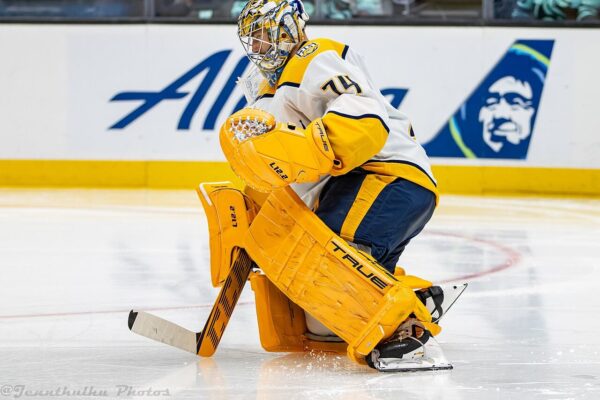
What separated him early was not just athleticism. Plenty of goalies are athletic. His game had order to it. He moved efficiently, tracked pucks through traffic and recovered well laterally, often making difficult saves look less dramatic than they were.
His first full season as the Rangers’ No. 1 came in 2021-22, and it became the breakthrough. Shesterkin led the NHL in save percentage at .935 and goals-against average at 2.07 among qualifying goaltenders. He won the Vezina Trophy and was named to the NHL First All-Star Team.
That spring produced one of the defining performances of his career. In Game 1 of the Rangers’ first-round playoff series against Pittsburgh on May 3, 2022, he made 79 saves in a triple-overtime loss. It set a franchise playoff record for saves in a game and stands among the highest single-game totals in Stanley Cup Playoff history.
Recognition around the league followed. He was selected to the NHL All-Star Game in 2023 and 2024, and by then he had firmly established himself as one of the NHL’s premier goaltenders.
The Rangers had already moved to secure him once, signing him on August 9, 2021, to a four-year extension worth $22,666,667, an average annual value of $5,666,667. Then came the bigger deal. On December 8, 2024, he signed an eight-year, $92 million extension with an $11.5 million cap hit, beginning in 2025-26. At the time of signing, it set a new high-water mark for NHL goaltenders in average annual value.
Some contract noise surfaced before that agreement. Arthur Staple reported during the negotiation period that the sides were not close at one stage, and there was outside speculation about shorter-term preferences and even a possible long-term return to Russia. Those ideas remained speculation. The only firm outcome was the eight-year extension he signed with New York.
The numbers behind the reputation
Through the end of the 2025-26 season, Shesterkin had played 325 NHL regular-season games and recorded 187 wins, 22 shutouts, a 2.52 goals-against average and a .917 save percentage. Those totals underline both quality and workload.
His 2025-26 season line was 25-19-6 in 51 games, with a 2.50 goals-against average, a .912 save percentage and one shutout.
He also joined select company in franchise history, becoming one of only three Rangers goaltenders with at least three 30-win seasons, alongside Henrik Lundqvist and Ed Giacomin. That stat says something simple and useful: his peak was not a one-year flash.
International duty with Russia
Shesterkin’s international résumé is strong, even if one of its headline items came from the roster sheet more than the crease.
He represented Russia at the IIHF World Championship in 2017 and 2018, winning bronze in 2017. In 2018, he was part of the Olympic Athletes from Russia team that won gold at the Winter Olympics. He did not appear in a game at that tournament, but he was a member of the gold-medal team.
Why his style works
Listed at 6-foot-1 and around 199 pounds, Shesterkin is not built like the biggest modern goaltenders, which makes his edge work and timing even more important. He catches left and plays a technically sound butterfly style, but his game is not robotic. He reads developing plays well, gets square quickly and has the reflexes to survive broken sequences when structure disappears.
The best version of his game blends patience with explosiveness. He does not chase every puck. He lets plays come to him, then closes space fast. That is a big reason his crease presence can feel calm even when the save itself is difficult.
Off the ice: private by design
Away from hockey, Shesterkin has generally kept his life out of public view. That reserved streak is one of the more consistent descriptions attached to him by teammates and media around the Rangers. He rarely seeks the spotlight and tends to keep interviews short and measured.
His father’s background in professional soccer is a documented part of the family story, but beyond that, much of his private life has stayed private. That is worth respecting rather than filling with guesswork.
He has picked up nicknames over the years, including “Shesty.” Some broader labels have circulated as well, but those tend to say more about fan culture than about his public persona. In practice, his image is much simpler: a highly competitive goalie who does most of his talking in the crease.
One more rumor is worth handling carefully. A trade claim involving Ottawa circulated from a YouTube source in 2026, suggesting the Senators would push for him if he became available. That was unconfirmed speculation and never developed into a reported transaction path. Given his signed extension, it remained just that: speculation.
FAQ
What is Igor Shesterkin’s nationality?
He is Russian.
When was Igor Shesterkin drafted?
The New York Rangers selected him in the fourth round of the 2014 NHL Draft, 118th overall.
Has Igor Shesterkin won a Vezina Trophy?
Yes. He won the Vezina Trophy for the 2021-22 season.
Did Igor Shesterkin win Olympic gold?
Yes. He was part of the Olympic Athletes from Russia team that won gold in 2018, though he did not play in the tournament.
What number does Igor Shesterkin wear?
He wears No. 31 for the New York Rangers.
What is Igor Shesterkin’s contract with the Rangers?
He signed an eight-year, $92 million extension with New York on December 8, 2024, carrying an $11.5 million average annual value.
Photo: TheAHL, CC BY 4.0, via Wikimedia Commons