Forty-six saves in his NHL debut told the story early: Marc-Andre Fleury was never going to arrive quietly.
Long before he became one of the most familiar masks in hockey, Fleury was a teenage goaltending prodigy from Sorel-Tracy, Quebec, climbing through the province’s development system with the kind of athleticism that made scouts stop and stare. He played in the famed Quebec International Pee-Wee Hockey Tournament with Collège Français Rive-Sud, then spent time at the midget level with Collège Charles-Lemoyne before moving into major junior.
From Sorel-Tracy to the top of the draft
Fleury joined the Cape Breton Screaming Eagles of the QMJHL as a 15-year-old and played there from 2000 to 2004. Those years turned promise into profile. He was quick across the crease, aggressive without looking reckless, and unusually composed for a young goalie carrying heavy minutes.
By the time his draft year arrived, he was already known well beyond junior rinks in Quebec and Atlantic Canada. In 2002-03, he was named to the QMJHL Second All-Star Team and won the Mike Bossy Trophy, awarded for the league’s top professional prospect. He also starred for Canada at the World Junior Championship, where he was named the tournament’s best goaltender and most valuable player as Canada won silver. He returned the next year and helped Canada to another silver medal.
That combination, elite junior pedigree, international success, and rare upside at a position teams usually treat cautiously, made him one of the most intriguing players in the 2003 NHL Draft.
The Pittsburgh Penguins took him first overall.
That mattered. Goalies almost never go at No. 1, and Fleury became just the third netminder in NHL history to be selected first overall, after Michel Plasse and Rick DiPietro.
Learning on the fly in Pittsburgh
Pittsburgh put him in the NHL right away. On October 10, 2003, he made his debut against Los Angeles and stopped 46 shots in a 3-0 loss that somehow still felt like an announcement. Eight days later, he earned his first NHL win. Before the month was over, he had his first shutout and the league’s Rookie of the Month award for October.
The start was exciting, but it was not a straight line. Fleury played 21 games that season before being returned to Cape Breton. During the lockout year that followed, he also spent time with the Wilkes-Barre/Scranton Penguins of the AHL. For a goalie drafted that high, it was an early reminder that development is rarely smooth, even for the gifted ones.
Once he settled in for good, though, he became part of the spine of the Penguins’ rebuild. Pittsburgh grew from struggling franchise to contender around a core that included Sidney Crosby, Evgeni Malkin and Fleury, and the goalie’s role in that rise was substantial. He gave them athletic saves, durability, and an emotional spark that teammates and fans both responded to.
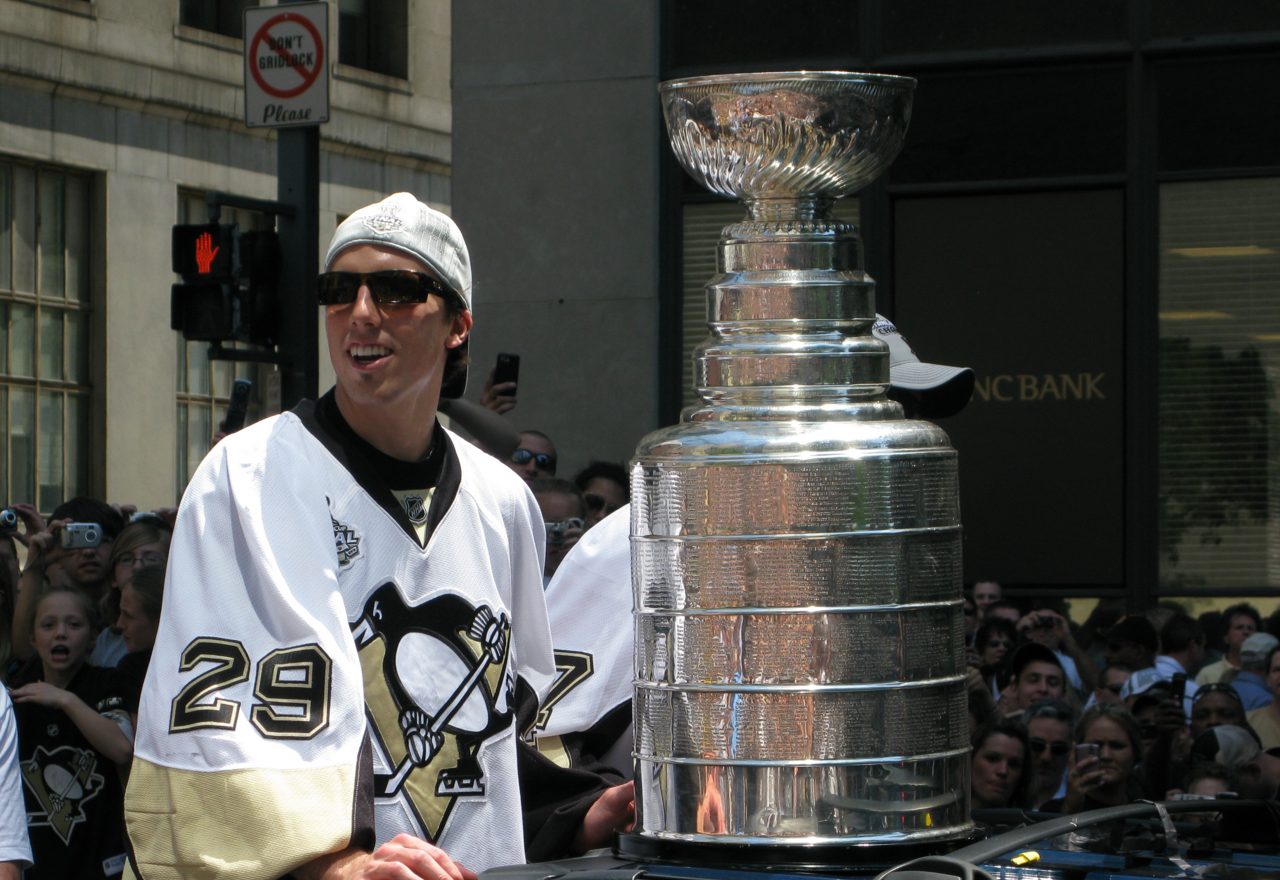
The breakthrough came in 2008, when the Penguins reached the Stanley Cup Final, though they lost to Detroit. A year later they got back, faced the Red Wings again, and this time finished the job. Fleury’s diving stop on Nicklas Lidstrom in the final seconds of Game 7 remains one of the defining images of Pittsburgh’s 2009 championship.
He would win three Stanley Cups with the Penguins in all: 2009, 2016 and 2017.
The later titles came during a more complicated phase of his Pittsburgh career. By 2016, Matt Murray had emerged and taken over much of the playoff workload, but Fleury still remained an important part of the team. In 2017, when Murray was injured during the opening round, Fleury stepped in and helped carry the Penguins through the first two rounds before Murray returned. That run said a lot about his place in the organization. Even when the role changed, he stayed useful, ready, and respected.
Pittsburgh also showed its faith in him financially. In November 2014, Fleury signed a four-year contract extension with an average annual value of $5.75 million.
By the end of his Penguins tenure, he had already built a resume that would have stood on its own: hundreds of wins, deep playoff mileage, and a long run as the face of the crease for one of the league’s marquee teams.
A new chapter in Vegas
Expansion drafts usually feel like endings. For Fleury, Vegas turned into a second peak.
The Golden Knights selected him in the 2017 expansion draft, and what looked at first like a difficult goodbye in Pittsburgh quickly became one of the best late-career moves any veteran goalie could have made. In Las Vegas, he was not just a starter. He became one of the faces of a brand-new franchise, central to its identity from day one.
In the club’s inaugural season, he went 29-13-4 with a 2.24 goals-against average and a .927 save percentage. Vegas stormed all the way to the Stanley Cup Final, and Fleury’s play was a major reason why. On March 12, 2018, he recorded the 400th win of his NHL career, another marker in a career that kept stretching well past the point when many goalies begin to fade.
His individual honors followed. Fleury was selected to five NHL All-Star Games over the course of his career, 2011, 2015, 2018, 2019 and 2020, but his biggest personal award came later in Vegas. In 2020-21, he won the Vezina Trophy as the league’s top goaltender and also shared the William M. Jennings Trophy after helping Vegas allow the fewest goals in the NHL.
That season mattered because it sharpened the picture of who he was as a player. Fleury was never just hanging around on reputation. Deep into his 30s, he was still capable of elite play.
Brief stop in Chicago, then the finish in Minnesota
Vegas traded Fleury to the Chicago Blackhawks in July 2021. The move was abrupt enough that it became a story in itself, but his time in Chicago was short. He played one season there, appeared in the All-Star Game again, and then moved on at the trade deadline.
In March 2022, the Blackhawks dealt him to the Minnesota Wild.
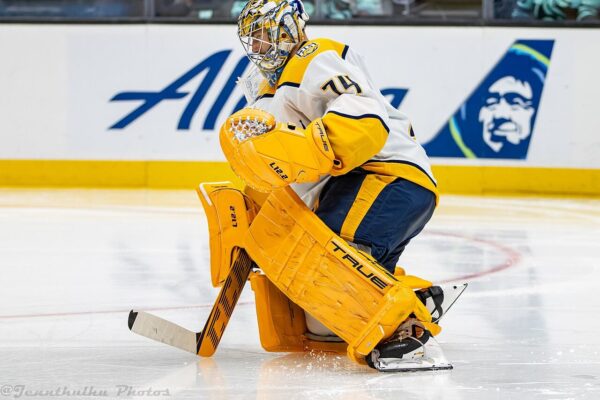
Minnesota became the final stop of his NHL career. The role was different now. He was no longer carrying the same load he had in Pittsburgh or Vegas, but he remained a valuable veteran presence and still gave the Wild quality starts. In his final season, he appeared in 26 games and posted a 14-9-1 record with a 2.93 goals-against average, a .899 save percentage, and one shutout.
When he stepped away after the 2024-25 season, the numbers captured both excellence and endurance. Fleury retired with 1,051 regular-season games, 575 wins, a 2.60 goals-against average, a .912 save percentage, and 76 shutouts. At the time of his retirement, he ranked second in NHL history among goaltenders in wins and games played.
His playoff totals were heavy too: 170 postseason appearances, 92 wins, and 16 shutouts. Few goalies in league history were used that often in games that mattered most.
Canada, big stages, and a gold medal
Internationally, Fleury’s name first became widely known at the World Juniors. His 2003 tournament was exceptional: silver medal, best goaltender, and MVP. He returned in 2004 and won another silver with Canada.
At the senior level, he was part of Canada’s gold-medal team at the 2010 Winter Olympics in Vancouver. He was not the starter behind Roberto Luongo and Martin Brodeur, but the gold still belongs on the résumé. It completed the international side of a career that had already covered junior stardom and NHL championships.
The game behind the grin
Fleury’s style always made him easy to recognize. He played a butterfly base, but his game was really about movement and reaction. He was explosive laterally, quick with both glove and pad, and willing to challenge shooters. At his best, he could make difficult saves look improvised in the best possible way.
He also brought a kind of visible joy to the position. Goaltending can turn inward; Fleury never entirely did. The smile, the pranks, the energy around teammates, those became part of his public image without overshadowing the work itself.
His nickname, “Flower,” comes from the English translation of his surname. It fit his personality, and it often showed up on his gear as well. Over the years, his masks regularly featured fleur-de-lis or floral elements, making him one of the easiest goalies in the league to identify from a distance.
Life away from the rink
Off the ice, Fleury has long kept a relatively grounded public profile. He is married to Véronique Larosee, and the couple have three children. Public reporting has identified their daughters as Estelle and Scarlett, and their son James was born in 2019. Larosee has spoken publicly about her Abenaki and Mi’kmaq heritage.
That family connection became part of a widely discussed moment late in Fleury’s career. In 2023, the NHL did not approve a custom warmup mask designed to honor Indigenous heritage connected to his wife’s family. Fleury wore the mask in warmups anyway, despite the possibility of a fine, and the episode drew attention well beyond Minnesota.
There are smaller details that help explain why he remained so popular for so long. Teammates and opponents alike tended to describe him as playful and approachable, and that image matched what fans saw for two decades. Even after becoming a first overall pick, a Cup winner, and a Vezina recipient, he never looked like someone trying to act the part of a star.
Marc-Andre Fleury’s place in hockey
Some careers are defined by a short peak. Fleury’s was defined by range.
He arrived as a teenage phenom, became a first overall pick, won in Pittsburgh, found a second act in Vegas, and lasted long enough to finish with the Minnesota Wild while climbing near the top of the NHL’s all-time goaltending lists. Along the way he collected three Stanley Cups, Olympic gold, a Vezina Trophy, and a reputation as one of the most durable and recognizable goaltenders of his era.
That is the shape of the Marc-Andre Fleury story: talent early, pressure quickly, setbacks mixed in, then a remarkably long run that kept finding new chapters.
FAQ
How many Stanley Cups did Marc-Andre Fleury win?
He won three Stanley Cups with the Pittsburgh Penguins: 2009, 2016 and 2017.
When was Marc-Andre Fleury drafted?
He was selected first overall by the Pittsburgh Penguins in the 2003 NHL Draft.
What teams did Marc-Andre Fleury play for?
He played for the Pittsburgh Penguins, Vegas Golden Knights, Chicago Blackhawks and Minnesota Wild. He also spent time with the Wilkes-Barre/Scranton Penguins in the AHL.
What is Marc-Andre Fleury’s nickname?
He is widely known as “Flower,” a reference to the English meaning of his surname.
Did Marc-Andre Fleury win the Vezina Trophy?
Yes. He won the Vezina Trophy in 2021 while playing for the Vegas Golden Knights.
How many wins did Marc-Andre Fleury finish with?
He retired with 575 NHL regular-season wins.
Photo: Mameisam, CC BY-SA 3.0, via Wikimedia Commons