In the 2008 playoffs, Sean Avery turned his back on the puck and faced Martin Brodeur, waving his stick and hands in the goaltender’s sightline. By the following day, the NHL had clarified its unsportsmanlike-conduct rule. One shift had given hockey a new expression: the “Avery Rule.”
It was a concentrated version of his career: inventive, confrontational and difficult to ignore. But the undrafted forward also played 580 NHL games and scored 247 points. Keeping a roster spot required more than getting under someone’s skin.
An undrafted route out of Ontario
Sean Christopher Avery was born on April 10, 1980, in North York, Ontario. He grew up in a family of teachers: his parents, Al and Marlene, both worked in education.
His hockey education took place in Ontario’s minor and junior leagues. After playing in the Markham system, he entered the Ontario Hockey League with the Owen Sound Platers. He later moved to the Kingston Frontenacs, finishing his junior career in 2000.
No NHL team drafted him. Detroit signed him as a free agent in 1999, before his final junior season, offering a route into an organization with considerably more established talent ahead of him.
He turned professional with the Cincinnati Mighty Ducks in 2000. The American Hockey League gave the left-shooting forward somewhere to develop his game-and test how far his abrasive approach could carry him against older players.
Detroit: learning to stay in the lineup
Avery reached the NHL with the Red Wings during the 2001-02 season. At a listed 5-foot-10 and 195 pounds, he was not an imposing heavyweight. His usefulness depended on skating, pressure and a willingness to make every encounter uncomfortable.
Detroit won the Stanley Cup that season, but his place in the organization should not be confused with having his name on the trophy. He played 36 regular-season games and none in the playoffs, falling short of the standard engraving requirements.
Across parts of two seasons with the Red Wings, he recorded seven goals and eight assists in 75 games, alongside 188 penalty minutes. There were also AHL assignments, including time with the Grand Rapids Griffins.
The breakthrough would have to come elsewhere. In March 2003, Detroit sent him to Los Angeles in the trade that brought defenseman Mathieu Schneider to the Red Wings.
Los Angeles: production alongside provocation
The Kings gave Avery a longer opportunity to establish himself. From his arrival in 2003 until his departure in February 2007, he played 218 games for Los Angeles, collecting 35 goals and 64 assists.
His reputation grew faster than his scoring totals.
He led the NHL with 261 penalty minutes in 2003-04, then led it again with 257 in 2005-06. Between those seasons, the NHL lockout took him to Finland’s Lahti Pelicans and the Motor City Mechanics of the United Hockey League.
There was offense behind the commotion. His 15 goals and 39 points in 2005-06 demonstrated that he could contribute beyond a checking-line assignment. He pursued loose pucks, worked around the crease and had enough skill to punish opponents who treated him only as a distraction.
The difficulty was separating useful irritation from penalties that hurt his own team. That tension followed him through the rest of his career.
On February 5, 2007, the Kings traded him to the Rangers. New York offered a bigger stage-and a team that found an immediate use for his particular combination of energy and antagonism.
New York and a rule with his name on it
Avery scored 20 points in 29 regular-season games after the trade, helping the Rangers reach the 2007 playoffs. He followed with 15 goals and 33 points in 57 games the next season.
Wearing No. 16, he became a conspicuous presence at Madison Square Garden. His shifts could include a productive forecheck, a scoring chance and an argument, sometimes in quick succession.
Then came Game 3 against New Jersey on April 13, 2008.
During a Rangers power play, he positioned himself directly in front of Brodeur. Rather than following the puck with his body, he faced the goaltender and waved his stick and hands to obstruct and distract him.
Screening a goalie was routine. This was different.
The NHL announced the next day that such face-to-face actions could draw an unsportsmanlike-conduct penalty. Commonly called the “Avery Rule,” it was a clarification of how an existing rule would be applied, rather than a wholesale ban on screening.
The incident became his most enduring hockey image. It also overshadowed a productive first spell in New York: 53 points in 86 regular-season games.
Dallas, suspension and the way back
In July 2008, the Dallas Stars signed Avery to a four-year, $15.5 million contract. The commitment suggested a substantial role. Instead, he played only 23 games for the franchise.
In December, the NHL suspended him for six games following a derogatory public comment about former girlfriends and other NHL players. The Stars subsequently announced that he would not return to their team.
His contract was not terminated. That distinction matters to what happened next.
After an AHL spell with the Hartford Wolf Pack, the Rangers claimed him on re-entry waivers in March 2009. Under the rules then in place, Dallas remained responsible for half his salary and cap charge.
Back in New York, he recorded 12 points in 18 games to finish the regular season. He remained with the organization through 2011-12, although his final season included an extended assignment with the Connecticut Whale.
Avery announced his retirement in March 2012. His NHL career ended with 90 goals, 157 assists and 1,533 penalty minutes in 580 games. Across both Rangers stints, he contributed 123 points in 264 games-his longest stay with any NHL club.
A brief comeback attempt with the ECHL’s Orlando Solar Bears in 2022 ended without a game appearance.
The player behind the penalty totals
Calling him an agitator is accurate, but incomplete.
At his best, Avery used his skating to arrive early on the forecheck and his persistence to keep opponents occupied after the first challenge. He could retrieve pucks, create space and finish chances. His career totals reflect a player who supplied secondary offense, not simply someone employed to fight.
The risk was built into the method. Drawing an opponent into a penalty could help; taking one himself could undo an otherwise effective shift. His career repeatedly tested that boundary, with the Dallas suspension providing the clearest example of the consequences.
He was useful enough to earn repeated opportunities. He was also disruptive enough that those opportunities rarely came without complications.
Away from the rink: fashion, family and film
Fashion was already part of Avery’s life before his playing career ended. During the 2008 offseason, he interned at Vogue, an unusual summer assignment for an active NHL forward.
After hockey, he worked with the advertising and creative agency Lipman and pursued restaurant ventures, including New York sports bar Warren 77. These were distinct interests rather than extensions of a conventional broadcasting career.
His screen work also stretched across the boundary between active player and retiree. He appeared in the hockey film The Rocket in 2005 and later had small roles in Christopher Nolan’s Tenet and Oppenheimer. In 2014, he competed on Dancing with the Stars.
Writing gave him a longer format. His 2017 memoir, Ice Capades: A Memoir of Fast Living and Tough Hockey, revisited his playing career and life outside the dressing room. He later hosted the podcast No Gruffs Given.
He married model Hilary Rhoda in October 2015, and they welcomed a son in 2020. Rhoda filed for divorce in 2022, according to contemporaneous reporting. Subsequent rumors about their relationship do not establish their marital status and should not be presented as fact.
His public advocacy was another significant part of his off-ice life. In May 2011, while still playing for the Rangers, he appeared in a New Yorkers for Marriage Equality video supporting same-sex marriage. He joined Athlete Ally’s advisory board in 2012, supporting efforts to challenge homophobia in sport.
Those choices broadened a public identity often reduced to penalties and confrontation. Fashion, performance and advocacy were not sidelines he discovered only after leaving hockey; several were already taking shape while he was still playing.
FAQ
What are Sean Avery’s career NHL stats?
He recorded 90 goals, 157 assists and 247 points in 580 regular-season games, with 1,533 penalty minutes.
Which NHL teams did he play for?
He played for the Detroit Red Wings, Los Angeles Kings, New York Rangers and Dallas Stars. He had two separate stints with the Rangers.
What is the “Avery Rule”?
It is the nickname for a 2008 NHL rule clarification allowing an unsportsmanlike-conduct penalty when a player faces a goalie and waves his hands or stick to distract him.
Did he win the Stanley Cup?
He belonged to Detroit’s organization during its 2002 championship season, but did not meet the standard requirements to have his name engraved on the Cup.
When did he retire?
He announced his retirement in March 2012. A short-lived ECHL comeback attempt in 2022 produced no game appearances.
What did he do after hockey?
His work included fashion, advertising, restaurants, acting, writing and podcasting. He also publicly supported LGBTQ+ inclusion in sport.
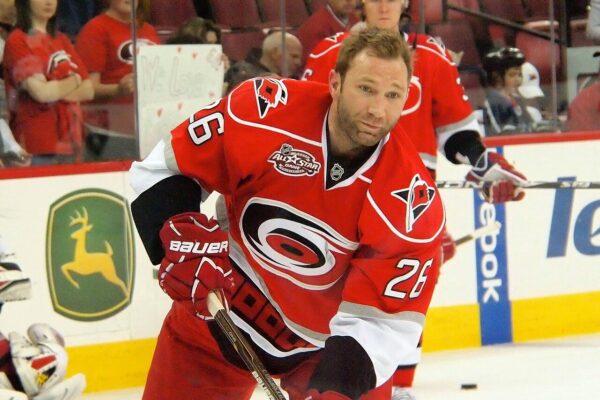
Photo: Eddie Collins, CC BY-SA 3.0, via Wikimedia Commons