
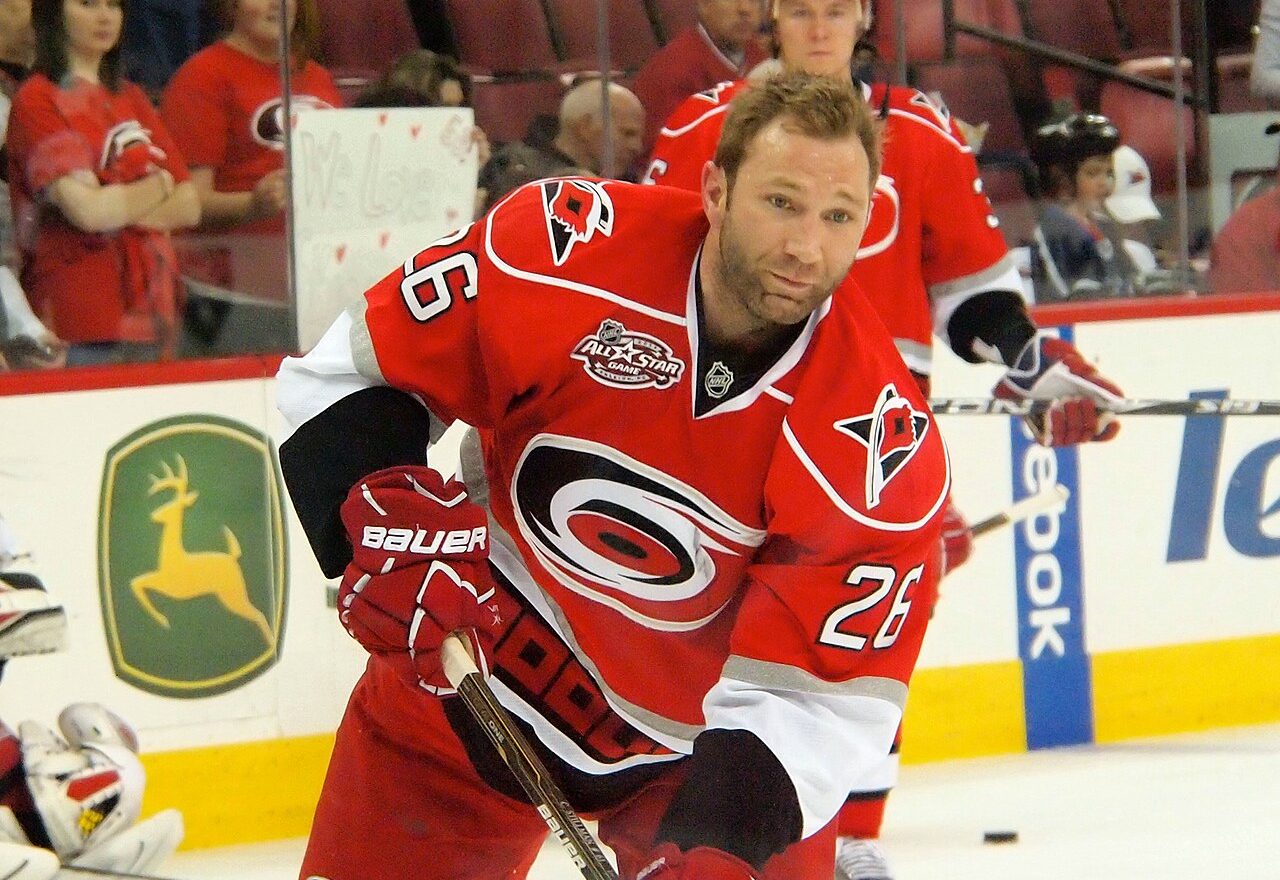
A fractured neck vertebra kept Erik Cole out of the first three rounds of the 2006 Stanley Cup playoffs. By Game 6 of the Final, he was back in the Carolina Hurricanes’ lineup. Two nights later, he was a Stanley Cup champion.
That return was the most dramatic moment of a career built on speed, contact and a willingness to drive toward the net. The first NHL player from Oswego, New York, Cole played 892 regular-season games across five franchises, finishing with 265 goals and 532 points. Carolina was his longest hockey home, but his route also included a German championship and a career-high 35-goal season in Montreal.
From Oswego to a chance with Carolina
Born on November 6, 1978, Erik Thomas Cole learned the game through the Oswego Minor Hockey Association before playing for Oswego High School from 1994 to 1996. His next move took him out of New York and into the United States Hockey League.
With the Des Moines Buccaneers in 1996-97, he scored 64 points in 48 games and earned USHL Second All-Star Team honors. Clarkson University followed, giving the left wing three seasons of college hockey in which to develop his game.
Carolina selected him 71st overall in the third round of the 1998 NHL Entry Draft, after his freshman season. He returned to Clarkson and earned ECAC First All-Star Team and NCAA East Second All-American recognition in 1998-99.
Cole turned professional in 2000, joining the Cincinnati Cyclones of the International Hockey League after his college season. He spent the following campaign there as well before making Carolina’s NHL roster in 2001.
At 6-foot-2 and roughly 205 pounds, he had the size for a physical role. His skating made him more than a winger who could finish a check.
A rookie run to the Stanley Cup Final
Cole arrived in the NHL with a team ready to make an unexpected playoff run. He scored 16 goals and 40 points in 81 games during his rookie season, then became part of Carolina’s “BBC Line” with Bates Battaglia and Rod Brind’Amour.
The nickname came from their surnames; the line’s usefulness came from its blend of puck pursuit, strength and direct attacking play. Carolina reached the 2002 Stanley Cup Final before losing to Detroit in five games.
For Cole, it was an unusually deep introduction to playoff hockey. He contributed six goals and nine points in 23 postseason games, establishing himself as more than a regular-season prospect.
His game was taking shape: accelerate through the neutral zone, challenge defenders wide and make the trip to the crease uncomfortable for anyone trying to stop him.
Berlin, a broken neck and the 2006 championship
The 2004-05 NHL lockout sent Cole to Eisbären Berlin. Rather than simply filling time overseas, he helped the club win the German DEL championship and earned playoff MVP honors.
Back in Carolina the following season, he scored 30 goals and 59 points in just 60 games. There was an unusual piece of NHL history, too: against Buffalo on November 9, 2005, he became the first player awarded two penalty shots in one game.
Then came the injury that threatened far more than his season.
On March 4, 2006, a hit from Pittsburgh defenseman Brooks Orpik sent Cole into the boards and fractured a vertebra in his neck. While the Hurricanes advanced through the playoffs, he worked toward medical clearance rather than a guaranteed return date.
He finally rejoined the lineup for Game 6 of the Stanley Cup Final against Edmonton. Carolina lost that night, but won Game 7 at home to secure the franchise’s first championship.
Cole played only those final two postseason games. His contribution to the title season, however, included the 30 goals that had helped put Carolina in position to contend.
Edmonton and the road back
Carolina traded Cole to Edmonton on July 1, 2008, in exchange for defenseman Joni Pitkänen. The move ended his first stint with the Hurricanes, though not for long.
He recorded 16 goals and 27 points in 63 games for the Oilers before a three-team trade brought him back to Carolina on March 4, 2009. The Hurricanes then reached the Eastern Conference Final, with Cole appearing in all 18 of their playoff games.
That July, he signed a two-year, $5.8 million contract to stay.
Across his two Carolina spells, he accumulated 168 goals, 195 assists and 363 points in 557 regular-season appearances. His final season before leaving again, 2010-11, produced 26 goals and a full 82-game schedule-a useful reminder of the durability he could offer after his earlier injuries.
Montreal brings a scoring peak
On July 1, 2011, Cole signed a four-year, $18 million contract with the Montreal Canadiens. Moving to a new team in his thirties did not slow his production.
He scored a career-high 35 goals in 2011-12 and added 26 assists. His 61 points matched his previous best, set with Carolina in 2006-07.
Montreal struggled as a team, but Cole gave the Canadiens a winger who could create chances through speed and a direct route to the net. His most memorable night came against Ottawa on March 23, 2012.
By 5:41 of the first period, he had completed a natural hat trick-the fastest from the start of a game in Canadiens history. Three goals before many games have found their rhythm made for a striking entry in the club’s record book.
His stay lasted less than two seasons. On February 26, 2013, Montreal traded him to Dallas for Michael Ryder and a third-round draft pick.
Dallas, Detroit and an injury-enforced finish
Cole played 160 games for the Stars across parts of three seasons, scoring 42 goals and 75 points. Dallas then traded him to Detroit on March 1, 2015, giving the veteran another opportunity with a playoff contender.
That final stop was brief. He managed three goals and three assists in 11 games before suffering a spinal contusion against Arizona on March 24, 2015. He never played another NHL game.
His formal retirement came on September 20, 2017, when he signed a ceremonial contract to retire as a Hurricane and took on an ambassador role with the organization.
His final regular-season totals were 265 goals, 267 assists and 532 points in 892 games. In the playoffs, he added six goals and eight assists over 46 appearances.
An American power forward with pace
Alongside his club career, Cole represented the United States at the 2005 and 2007 World Championships and the 2006 Winter Olympics in Turin.
“Power forward” suited him, provided the description included his speed. He could carry the puck into traffic, push defenders backward and force them to account for his reach and strength. Physical play was part of the package, not the whole explanation for his effectiveness.
His best seasons combined those qualities with consistent finishing. The 35-goal campaign in Montreal was his scoring peak, while his longer Carolina record showed how valuable that style could be over several seasons.
Family, Oswego and hockey beyond the NHL
Public profiles have identified Cole’s wife as Emily and their children as Bella and Landon. He has generally kept family life less prominent than his work around hockey and his hometown.
Through the Erik Cole Dream Big Foundation, his charitable efforts have included support for the Oswego Public Library and the Oswego Minor Hockey Association. The latter brought his involvement back to the organization where he first learned the game.
His post-playing hockey work has also included youth coaching with the Charleston Colonials in South Carolina. Alongside his appointment as a Hurricanes ambassador, it offered a different connection to the sport: less about managing his own next shift, more about helping younger players prepare for theirs.
FAQ
Where is Erik Cole from?
He was born in Oswego, New York, on November 6, 1978, and became the city’s first NHL player.
How many Stanley Cups did he win?
He won one, with Carolina in 2006. He returned from a fractured neck vertebra to play the final two games of the championship series.
Which NHL teams did Erik Cole play for?
He played for the Carolina Hurricanes, Edmonton Oilers, Montreal Canadiens, Dallas Stars and Detroit Red Wings.
What were his career statistics?
He recorded 265 goals and 267 assists for 532 points in 892 NHL regular-season games.
What was his best scoring season?
His career-high 35 goals came with Montreal in 2011-12. His 61 points that season tied his career best from 2006-07 with Carolina.
Why did he stop playing?
A spinal contusion suffered in March 2015 ended his playing career. He formally retired as a Hurricane in September 2017.
Photo: Benjamin Reed, CC BY-SA 2.0, via Wikimedia Commons