895.
That was the number that finally moved Alexander Ovechkin past Wayne Gretzky on the NHL’s all-time regular-season goals list, when he scored for the Washington Capitals on April 6, 2025. By the end of that season, the chase had turned into ownership: Ovechkin stood alone at the top of one of hockey’s most famous records.
From a Moscow sports family to Dynamo Moscow
Alexander Mikhailovich Ovechkin was born on September 17, 1985, in Moscow, then part of the Soviet Union. Elite sport was already the family business. His mother, Tatyana Ovechkina, won two Olympic gold medals with the Soviet basketball team, and his father, Mikhail Ovechkin, played professional soccer.
Hockey arrived early and stayed. Ovechkin joined Dynamo Moscow’s system as a child and quickly developed into one of the most gifted young scorers in Russia. A well-known story from those years says he once snapped a goal frame with a shot as a boy. Whether polished a little by time or not, it fits the player he became: forceful, direct, and impossible to ignore once the puck was on his stick.
There was also grief early in his life. Ovechkin’s older brother Sergei died in a car accident when Alex was still a child. Ovechkin has long honored him, often pointing skyward after goals, and later named his first son after him.
Before North America got to know him, Dynamo Moscow already did. Ovechkin played senior hockey there from 2001 to 2005, appearing in 152 Russian Superleague games and recording 36 goals and 32 assists. At the same time, he was building a reputation in international junior play, representing Russia at the IIHF U18 World Championship and the World Junior Championship. He was part of Russia’s gold-medal team at the 2003 World Juniors, a sign that his rise was not just domestic hype but international fact.
By the time the 2004 NHL Draft arrived, he was one of the sport’s defining prospects. Washington selected him first overall.
A two-goal debut and a franchise built around him
His NHL debut on October 5, 2005, lasted all of one game before the introduction phase was over. Ovechkin scored twice against the Columbus Blue Jackets, and the Capitals immediately had their centerpiece.
He did not arrive as a finesse winger who needed protection. At 6-foot-3 and built like a power forward, he played with force from the start. The shot was the headline, of course, heavy, quick, and dangerous from almost anywhere in the offensive zone, but his game was never only about a one-timer. He hit, he drove through checks, he protected pucks, and he played with the kind of appetite for big moments that made him the natural face of the franchise.
The first major award came quickly. Ovechkin won the Calder Memorial Trophy in 2005-06 after scoring 52 goals and 54 assists for 106 points in 81 games. It was one of the strongest rookie seasons in league history and the beginning of a run in which he was named to the NHL First All-Star Team in each of his first five seasons, still a rare marker of how fast he established himself among the league’s elite.
The years when the trophies kept coming
There was a stretch in Washington when Ovechkin seemed to collect major awards as routinely as he scored from the left circle.
In 2007-08, he produced 65 goals and 112 points, won the Hart Memorial Trophy as league MVP, the Art Ross Trophy as scoring champion, the Maurice “Rocket” Richard Trophy as top goal-scorer, and the Ted Lindsay Award, voted by the players. That four-award sweep in one season captured the full picture: he was not just prolific, but dominant by every major measure the league had.
He won the Hart again in 2008-09 and 2012-13, and added more Ted Lindsay Awards in 2008-09 and 2009-10. The Rocket Richard Trophy became a recurring part of his résumé. Ovechkin won it in 2007-08, 2008-09, 2012-13, 2013-14, 2014-15, 2015-16, 2017-18, 2018-19 and 2019-20, giving him nine in total.
Washington committed to him accordingly. In January 2008, the Capitals signed him to a 13-year extension worth $124 million, one of the landmark contracts of its era. More than a decade later, in July 2021, he signed another extension, this one for five years and $47.5 million.
A brief return home during the lockout
When the NHL lockout halted the 2012-13 season, Ovechkin went back to familiar ground and played for Dynamo Moscow in the KHL. It was a short return, but a telling one. His career has always had two clear poles: Moscow, where he was formed, and Washington, where he became one of the defining players of his generation.
Once the NHL resumed, he returned to the Capitals and kept scoring.
The Stanley Cup that changed the conversation
For years, the discussion around Ovechkin always circled back to the same missing line: team success in the playoffs. The individual case was already secure. The championship question lingered.
It finally broke in 2018.
As captain, Ovechkin led Washington to the first Stanley Cup in franchise history, defeating the Vegas Golden Knights in five games. He scored 15 goals during that playoff run and won the Conn Smythe Trophy as postseason MVP. He also became the first Russian captain to lead an NHL team to the Stanley Cup.
That spring did not erase everything that came before it; it reframed it. The career was no longer about what he had not done in May and June. It was about a superstar who had carried a franchise for years and, eventually, pushed it all the way through.
The records, the goals, and the chase that became a record of its own
Some players are remembered for style, some for awards, some for championships. With Alex Ovechkin, the numbers are inseparable from the story.
He broke Gretzky’s regular-season goals record by scoring his 895th goal on April 6, 2025. That moment had hovered over the league for years, turning every scoring surge into part of a larger countdown. Ovechkin reached it not as a late-career novelty act, but still as a productive scorer deep into his 30s.
Along the way, he built one of the most unusual statistical profiles the sport has seen. He owns the NHL record for most career regular-season goals, and he also set records for most power-play goals, most 40-goal seasons, most road goals, and most goals with one franchise. He shares the record for most 50-goal seasons, with nine.
The consistency may be just as striking as the peaks. Ovechkin kept finding 30 and 40 goals in seasons when most power forwards have already faded into support roles. That durability is part of why the Gretzky chase became real in the first place.
Because this is evergreen profile writing, the exact totals will continue to move depending on when a reader lands here. What will not change is the larger fact: the Washington Capitals captain turned the most famous scoring mark in hockey into his own.
Russia on the international stage
Ovechkin’s international résumé is extensive enough to stand on its own.
He represented Russia at the World U18 Championship, the World Junior Championship, the IIHF World Championship, the Winter Olympics, and the 2004 World Cup of Hockey. His senior national-team debut came while he was still a teenager, another sign of how quickly he was trusted at the highest level.
At the World Championship, he helped Russia win gold in 2008, 2012, and 2014. He also earned silver in 2010 and 2015, plus bronze in 2007 and 2016. He played at the Winter Olympics in 2006, 2010, and 2014.
For Russian hockey, he has long occupied a central place: a scorer with NHL star power who continued to show up for the national team whenever schedules allowed.
Why his game was bigger than the one-timer
The easiest way to describe Ovechkin is as a goal-scorer, and that is true as far as it goes. It just does not go far enough.
At his best, he was a power winger who could tilt a game physically as well as offensively. He hit hard, attacked defenders with speed, and turned puck protection into a weapon. His left-circle one-timer became one of the signature plays of the era, but defenders knew the problem was larger than one spot on the ice. He could score off the rush, from the slot, on rebounds, from bad angles, and with quick releases that beat goaltenders before they were set.
In his younger years especially, there was a violent energy to his game. He did not simply finish chances; he created chaos, then scored through it.
Off the ice: family, visibility, and public life
Away from hockey, Ovechkin’s public image has remained closely tied to family. He married Anastasia Shubskaya in 2016, and they have children together. Their first son, Sergei, was named in memory of Ovechkin’s late brother.
He has also been one of the NHL’s most marketable stars for much of his career. Endorsement deals, national ad campaigns, and video game covers followed naturally once he became one of the league’s most recognizable faces. He was the cover athlete for NHL 07, a fitting snapshot of how quickly he moved from top prospect to one of hockey’s central figures.
His charitable work has included “Ovi’s Crazy 8’s,” a long-running program that provides Capitals tickets to underserved children. That effort has been one of the more consistent parts of his off-ice profile in Washington.
Some reports have also linked Ovechkin to real-estate holdings and investment activity, but details on private finances beyond publicly reported contracts and endorsement estimates are limited and should be treated cautiously unless confirmed by named, reliable sources.
In 2017, he was named one of the NHL’s 100 Greatest Players, an honor that arrived before the Stanley Cup win and before he took over the all-time goals lead. In that sense, it now reads less like early praise than a midpoint summary.
FAQ
Has Alex Ovechkin won a Stanley Cup?
Yes. He won the Stanley Cup with the Washington Capitals in 2018.
When was Alex Ovechkin drafted?
He was selected first overall by the Washington Capitals in the 2004 NHL Draft.
What is Alex Ovechkin’s nickname?
The best-known nicknames are “Ovi” and “The Great 8.”
Did Alex Ovechkin play in Russia before the NHL?
Yes. He played for Dynamo Moscow before joining Washington and returned to Dynamo during the 2012-13 NHL lockout.
Is Alex Ovechkin married?
Yes. He married Anastasia Shubskaya in 2016.
What makes Alex Ovechkin’s playing style distinctive?
He combined elite goal-scoring with power-forward traits: a heavy shot, physical play, puck protection, and a willingness to attack defenders directly.
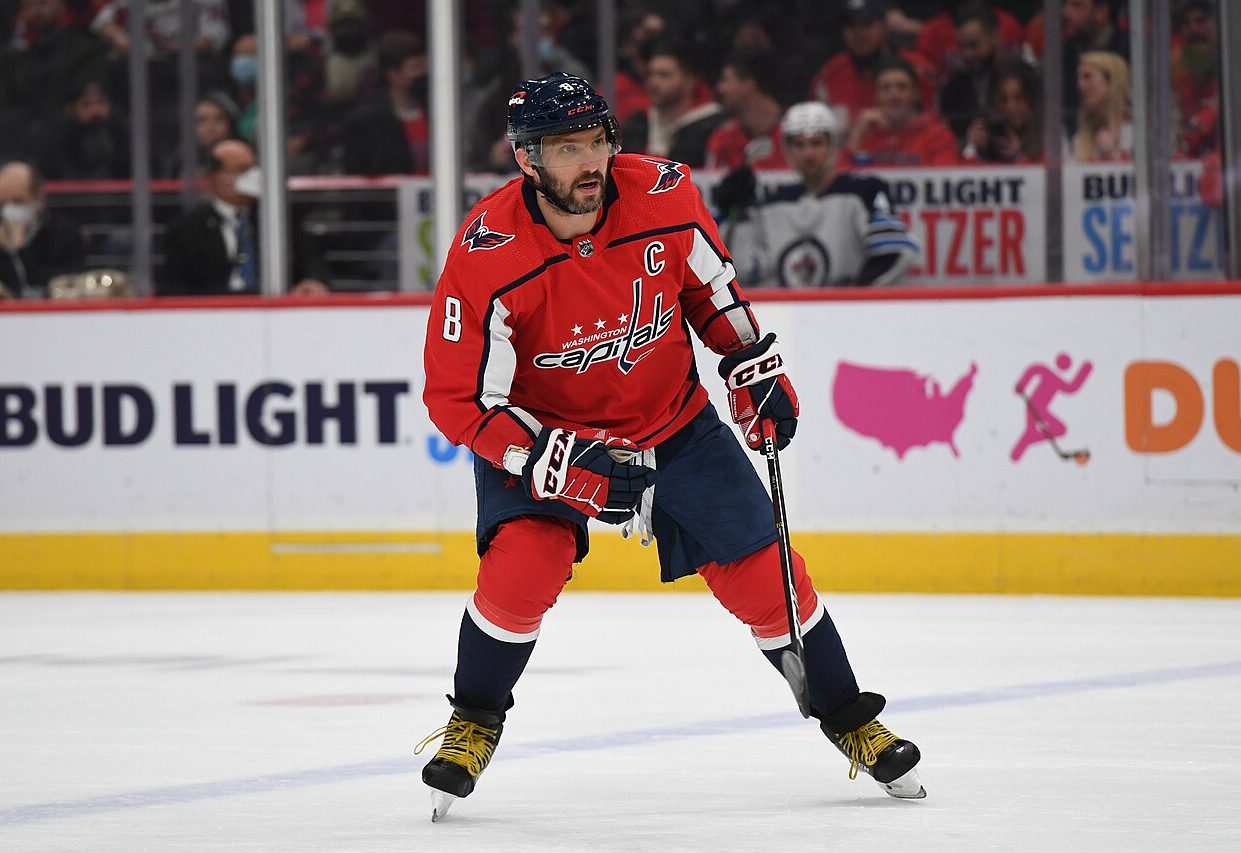
Photo: All-Pro Reels from District of Columbia, USA, CC BY-SA 2.0, via Wikimedia Commons