
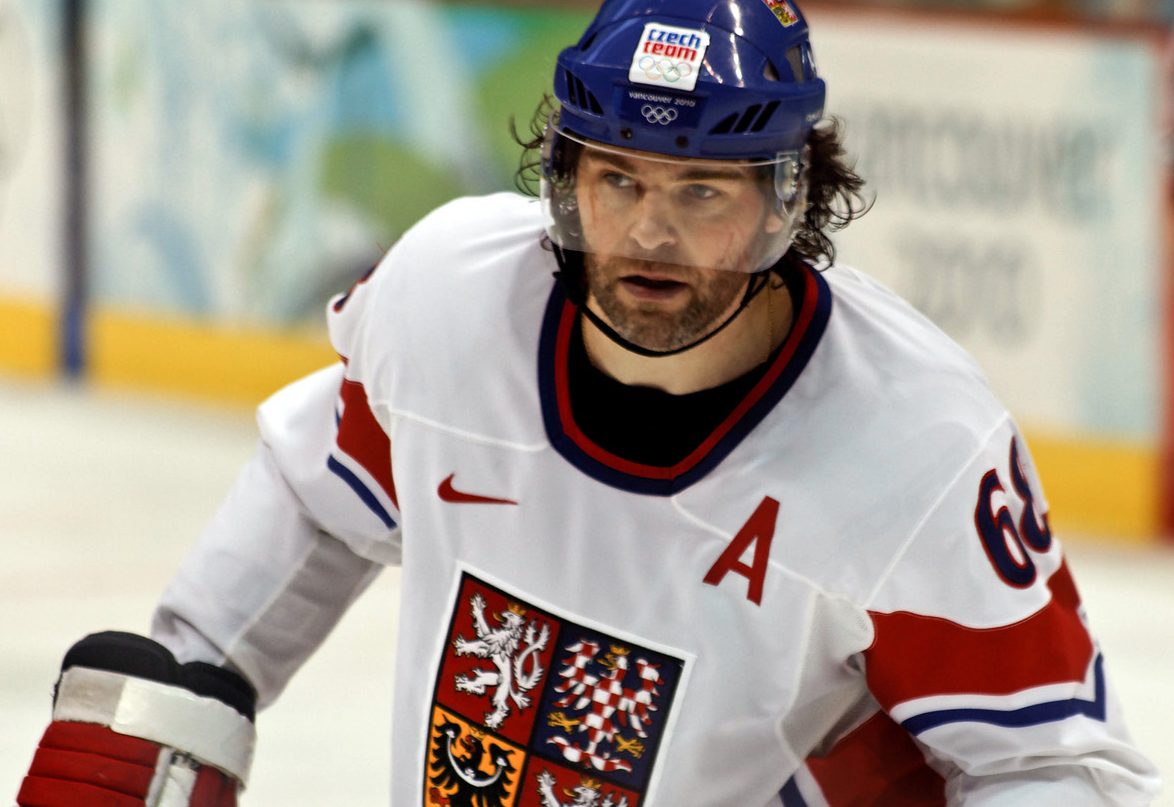
A black mullet, No. 68 on his back, and a habit of protecting the puck as if it belonged to him alone: Jaromír Jágr never looked quite like anyone else, and his career never unfolded like anyone else’s either. From communist-era Czechoslovakia to Stanley Cups in Pittsburgh, from scoring titles to a late-career return to his hometown club in Kladno, he built one of the longest and most productive runs hockey has seen.
He finished his NHL career with 1,921 points, second only to Wayne Gretzky, and with 766 goals and 1,155 assists across 1,733 games. That alone would secure his place in the sport. The rest of the story is what makes it memorable.
Jaromír Jágr’s start in Kladno
Jágr was born on February 15, 1972, in Kladno, then part of Czechoslovakia. Hockey came early. He was skating as a small child and, before long, playing against older competition in a system that quickly recognized how unusual his talent was.
By his mid-teens, he was already appearing at the senior level for HC Kladno. That was no ordinary step for a teenager in Czechoslovakia at the time. He also moved through the national-team pipeline, representing his country at junior levels and then, remarkably, reaching the 1990 World Junior Championship and the men’s World Championship in the same year. Czechoslovakia won bronze at both events.
Stories from those years have followed him for decades. One of the better-known ones, often repeated in profiles of Jaromír Jágr, is that he reportedly trained with improvised weights, including a tractor axle. Whether told with a little embellishment or not, it fits the image that stayed with him throughout his career: obsessive, strong, and willing to outwork almost anyone.
The number 68 also became part of his identity early. He wore it in memory of the Prague Spring and the Soviet-led invasion of Czechoslovakia in 1968, giving his jersey a personal and political meaning that set him apart as soon as he arrived in North America.
Drafted by the Penguins, then fast-tracked to stardom
The Pittsburgh Penguins selected him fifth overall in the 1990 NHL Draft, making him the highest-drafted Czechoslovak player to that point. He had admired Mario Lemieux from afar. Landing in Pittsburgh was not just a career break; it was the destination he wanted.
The transition was not seamless. Jágr was young, in a new country, and still learning English. Early in his rookie season, he stayed with the family of Penguins assistant coach Ivan Hlinka, then later with the family of former player Jiří Hrdina, both fellow Czechs who helped him settle in. On the ice, though, the adjustment came quickly. He made the NHL All-Rookie Team in 1990-91 and contributed to a Pittsburgh club that won the Stanley Cup that spring.
Then they won it again in 1992.
At first, Lemieux and the Penguins’ veteran core carried the spotlight. Before long, Jágr was impossible to miss. He had rare balance for a big winger, elite hands in traffic, and that signature move of shielding the puck with his body before slipping away from defenders. He could slow the game down without ever losing control of it.
By the middle of the decade, he was no longer just part of Pittsburgh’s attack. He was the engine.
The peak years in Pittsburgh
From 1994-95 through 2000-01, Jágr was one of the defining offensive players in the NHL. He won five Art Ross Trophies as the league’s leading scorer: 1994-95, 1997-98, 1998-99, 1999-2000, and 2000-01. He also won the Hart Trophy in 1998-99 as league MVP, along with the Lester B. Pearson Award, now known as the Ted Lindsay Award.
Those seasons were not built on finesse alone. His game was a blend of skill and force. Defenders knew what was coming and still struggled to stop it. He could beat coverage on the rush, create from the half wall on the power play, or simply hold the puck until a lane opened.
He was named to the NHL First All-Star Team in 1994-95, 1995-96, 1997-98, 1998-99, 1999-2000, and 2000-01, and to the Second All-Star Team in 1996-97.
In 1999, Pittsburgh signed him to a major contract extension, a six-year deal worth $68 million. It reflected his place in the league at the time: not a promising star anymore, but one of the faces of the sport.
Washington never quite fit, New York revived him
In the summer of 2001, the Penguins traded Jágr to the Washington Capitals. The move was driven largely by Pittsburgh’s financial pressures, and it ended an era. Washington then signed him to a seven-year, $77 million contract that carried enormous expectations.
The production was still good by normal standards. By Jágr standards, it felt uneven. He scored 79 points in his first season in Washington, then 52 in an injury-shortened second year. The fit never looked natural, and the Capitals eventually moved him again.
During the 2004-05 NHL lockout, he returned to Kladno and played at home. That pattern would repeat throughout his career. Whenever the NHL paused or changed around him, Kladno remained the constant.
In January 2004, Washington traded him to the New York Rangers. It took time, but New York gave him another true peak. In 2005-06, he scored 54 goals and 123 points, set a Rangers single-season points record, and earned another First All-Star Team selection. For a player already deep into his career, it was a reminder that his top gear had not disappeared.
The KHL chapter and one more long NHL run
After the 2007-08 season, Jágr left for Avangard Omsk of the Kontinental Hockey League, where he played from 2008 to 2011. It was not a farewell tour. He remained a top-level player and a major draw.
Then came another turn. In 2011, he returned to the NHL with the Philadelphia Flyers, a move that surprised plenty of people given his long history with Pittsburgh. He produced immediately, then kept moving through the league in short but useful stops: Dallas, Boston, New Jersey, Florida, and Calgary.
That late NHL stretch added texture to his career. He was no longer the league’s leading scorer, but he was still effective, still dangerous on the puck, and still capable of changing a game with patience and strength rather than speed alone.
With the Boston Bruins in 2013, he reached the Stanley Cup Final for the first time since 1992. The 21-year gap between Final appearances set an NHL record.
In Florida, he had another productive run and won the Bill Masterton Memorial Trophy in 2015-16. He also passed Gordie Howe for third on the NHL’s all-time goals list and later moved into sole possession of second place in points among NHL scorers, behind only Gretzky.
When his NHL career ended after a brief stint with Calgary in 2017-18, the numbers were staggering: 1,733 games, 766 goals, 1,155 assists, 1,921 points. He remains the highest-scoring European-born player in NHL history.
Among the records tied to his name: most game-winning goals in NHL history with 135, and the distinction of being the oldest player to score an NHL hat trick. He was also the first European-trained player to reach 1,000 NHL assists.
Back where it started: Rytíři Kladno
Long after most stars would have retired, Jágr kept returning to the club that shaped him. He became majority owner of Kladno in 2011, helping stabilize the organization financially and publicly. Later, under the Rytíři Kladno name, he also kept taking shifts for the team.
That dual role is one of the most unusual parts of the Jaromír Jágr story. He was not simply a former NHL star making ceremonial appearances at home. He was involved in the club’s survival and identity, and he continued to play meaningful games well past the age when almost every elite player has long since stopped.
In February 2023, he scored his 1,100th professional goal across all competitions, according to widely cited career totals. In April 2024, at 52 years and 63 days old, he became the oldest player to score a goal in professional hockey.
For readers looking for Jaromír Jágr stats beyond the NHL, that is part of the appeal: his career stretches across eras, leagues, and political systems. It is not just long. It is unusually broad.
International success and the Triple Gold Club
His international résumé is nearly as deep as his club career.
Jágr represented Czechoslovakia and later the Czech Republic across multiple generations of tournaments. He played at the Olympics in 1998, 2002, 2006, 2010, and 2014. The high point came in Nagano in 1998, where the Czech team won Olympic gold in one of the country’s defining hockey achievements. He later added Olympic bronze in 2006.
At the World Championships, he won gold in 2005 and 2010, plus bronze in 1990 and 2011. Add in the two Stanley Cups from Pittsburgh, and he became a member of the Triple Gold Club.
That international career mattered because it showed another side of him. In the NHL, he was often the puck-dominant star. With the national team, especially later on, he also became a bridge between generations and a symbol of Czech hockey’s modern era.
How Jaromír Jágr played
At his best, he was one of the hardest forwards in hockey to separate from the puck. He stood 6-foot-3, shot left, and used his reach and lower-body strength as well as any winger of his time. He could attack off the rush, work the boards, run a power play from the right side, and finish in tight.
What made him special was the combination. Plenty of players had hands. Plenty had size. Few had both, and fewer still could sustain that level for so long.
His style also aged well. Even when his speed declined, his puck protection, vision, and timing remained. That is a big part of why the Jaromír Jágr career lasted far beyond the normal arc of a superstar.
Life away from the rink
Kladno stayed at the center of his off-ice life. His father, Jaromír Sr., and mother, Anna, were both part of the family business background in the region, and Jágr’s connection to his hometown never looked cosmetic. Owning the local club made that even clearer.
He has also been involved in business ventures in the Czech Republic, including hospitality and branded merchandise. Some reports have described broader development interests as well, though details have not always been publicly documented in depth.
His charitable work has surfaced regularly in Czech coverage. In 2022, for example, he took part in efforts to support Ukrainian families displaced by the Russian invasion, including a charity event in Kladno.
Not every off-ice story has been flattering. In the past, Czech media reported on gambling-related debts connected to internet betting. Those reports have long been part of his public record, but they should be treated as reported claims rather than expanded beyond what was published. He was also suspended once in the NHL, in 2003, for bumping a referee during an argument while with Washington.
As for his personal life, it has often drawn tabloid attention in the Czech Republic. Unless confirmed by reliable public reporting, those details are better treated cautiously. One hockey-related rumor that has circulated is that he was reportedly considered, according to Puck Prose, in connection with a Mario Lemieux-led ownership bid involving the Penguins. That remains speculation, not an established role.
Legacy
There are cleaner careers, and there are shorter ways to greatness. Jágr’s path was neither. It crossed continents, outlasted rivals, and kept circling back to the same hometown rink where it began.
The numbers explain a lot: second in NHL points, the top-scoring European in league history, five scoring titles, a Hart Trophy, two Stanley Cups, Olympic gold, and a place in the Triple Gold Club. But the fuller picture is more interesting than the totals. Jaromír Jágr stayed relevant in hockey for so long that he became a link between generations, from Mario Lemieux’s Penguins to modern Czech club hockey.
That is a rare kind of career. In some ways, it is several careers stacked together.
FAQ
How old is Jaromír Jágr?
He was born on February 15, 1972.
What teams did Jaromír Jágr play for?
He played for HC Kladno/Rytíři Kladno, the Pittsburgh Penguins, Washington Capitals, New York Rangers, Avangard Omsk, Philadelphia Flyers, Dallas Stars, Boston Bruins, New Jersey Devils, Florida Panthers, and Calgary Flames.
How many Stanley Cups did Jaromír Jágr win?
He won two, both with the Pittsburgh Penguins in 1991 and 1992.
Is Jaromír Jágr still playing hockey?
He has continued playing for Rytíři Kladno deep into his 50s, alongside his role as the club’s owner.
What are Jaromír Jágr’s biggest records?
He ranks second in NHL points with 1,921, holds the NHL record for game-winning goals with 135, and is the highest-scoring European-born player in league history.
What is Jaromír Jágr’s net worth?
Public estimates vary widely, and no verified figure is available.
Photo: s.yume ., CC BY 2.0, via Wikimedia Commons