On April 6, 2025, Alexander Ovechkin scored from the place every opponent knew he wanted to shoot: the left faceoff circle. The power-play goal against New York Islanders goaltender Ilya Sorokin was the 895th of his NHL regular-season career, moving him past Wayne Gretzky into first place.
There was something fitting about the setting. For years, teams had built penalty-killing plans around stopping that shot. Knowing it was coming and keeping it out were different jobs.
The record belonged to a Washington Capitals left wing whose career had already included three MVP awards, a Stanley Cup and two decades of goals scored with remarkably little mystery about his intentions.
A sporting childhood in Moscow
Alexander Mikhailovich Ovechkin was born in Moscow on September 17, 1985, into a family familiar with elite competition. His mother, Tatyana Ovechkina, won Olympic basketball gold with the Soviet Union in 1976 and 1980. His father, Mikhail, played soccer for Dynamo Moscow.
Hockey became the youngest son’s game. He entered Dynamo’s youth system and developed the direct, forceful approach that would later distinguish him in Washington.
His childhood also carried a profound loss. His older brother Sergei died following a car accident when Ovechkin was 10. In interviews, he has described his brother’s encouragement and the lasting importance of his memory. Years later, he named his first son Sergei in his honor.
By 16, Ovechkin was playing senior hockey for Dynamo in the Russian Superleague. International tournaments gave NHL scouts further evidence of his scoring ability, and he helped Russia win gold at the 2003 World Junior Championship.
He was no longer simply a promising teenager in Moscow. By the time the 2004 NHL draft arrived, he was the first name called.
Washington’s first pick makes himself heard
The Capitals selected Ovechkin first overall in 2004, but a labor dispute delayed his arrival. The NHL canceled its entire 2004-05 season, leaving him in Russia, where he helped Dynamo win the Superleague championship.
He finally made his NHL debut on October 5, 2005, against the Columbus Blue Jackets. He scored twice in Washington’s 3-2 victory.
That opening night offered a fair preview: heavy contact, repeated shots and an obvious appetite for the puck. At 6-foot-3, with a right-handed shot and the strength to drive through defenders, he was difficult to mistake for anyone else.
His first season also produced one of his most replayed goals. Against Phoenix in January 2006, he fell while attacking the net, rolled onto his back and still swept the puck past the goaltender.
The spectacular finish sat inside a substantial rookie campaign: 52 goals, 54 assists and 106 points in 81 games. He won the Calder Memorial Trophy ahead of a rookie class that included Sidney Crosby.
Washington had finished outside the playoffs, but its rebuild now had a player around whom everything else could be arranged.
Goals, awards and unfinished playoff business
In 2007-08, Ovechkin scored 65 goals and finished with 112 points. He won the Art Ross Trophy as the league’s leading scorer, the Maurice “Rocket” Richard Trophy as its leading goal scorer and the Hart Memorial Trophy as MVP.
His fellow players also voted him the winner of the Lester B. Pearson Award, later renamed the Ted Lindsay Award. He earned that players’ award in three consecutive seasons, from 2008 through 2010.
Another Hart followed in 2009. A third came in the lockout-shortened 2012-13 season, when he scored 32 goals in 48 games.
The totals reflected more than finishing accuracy. In 2008-09, he put 528 shots on goal, the second-highest single-season total in NHL history behind Phil Esposito’s 550. Ovechkin kept shooting through missed chances, tight coverage and stretches when the puck refused to go in.
Washington became a regular playoff team, and he was named captain in January 2010. Yet strong regular seasons repeatedly ended without a championship. Series losses to Pittsburgh, the New York Rangers and other opponents made postseason disappointment a recurring part of his story.
The individual honors kept arriving. The missing achievement was shared.
The spring Washington finally broke through
The Capitals’ 2018 playoff run began badly: two home losses to Columbus. They recovered to win that series in six games, then faced Pittsburgh, the opponent associated with some of their most painful exits.
This time, Washington advanced. A seven-game Eastern Conference Final victory over Tampa Bay followed, sending the Capitals to face the expansion Vegas Golden Knights.
On June 7, 2018, Washington won Game 5 in Las Vegas to secure the franchise’s first Stanley Cup.
Ovechkin finished the postseason with 15 goals and 27 points in 24 games, earning the Conn Smythe Trophy as playoff MVP. When he accepted the Cup, his expression supplied the context that the statistics could not: thirteen NHL seasons had led to that moment.
The celebrations became part of Washington sports history, from the parade to public appearances with the trophy. He also took the Cup to Russia, including a visit to the Dynamo club where his career began.
Chasing Gretzky, one season at a time
After the championship, the pursuit of Gretzky’s 894 regular-season goals gradually became the central statistical story.
Ovechkin reached 700 in February 2020 and 800 in December 2022. Later that December, his 802nd moved him ahead of Gordie Howe into second place.
The chase was not uninterrupted. A fractured left fibula sidelined him during the 2024-25 season, but he returned and resumed scoring. On April 4, 2025, two goals against Chicago brought him level with Gretzky at 894. Two days later, he took the record outright against the Islanders.
He finished that regular season with 44 goals, bringing his career total to 897. It was his 14th season with at least 40 goals, extending his NHL record. He had also matched Gretzky and Mike Bossy with nine 50-goal seasons and won the Rocket Richard Trophy a record nine times.
Those are historical milestones rather than a live career tally. The central distinction is equally important: his record concerns NHL regular-season goals. Playoff goals are counted separately.
Why “Ovi’s office” worked
The left circle became known as “Ovi’s office,” but the nickname can make the method sound simpler than it was.
He adjusted his feet, opened his body and found passing lanes while defenders tried to deny him the puck. His one-timer combined power with a quick release; sometimes the decisive detail was a small change in position before the pass arrived.
He could also score off the rush, through traffic and around the crease. Physical contact was part of his attacking game, not a separate attraction. He finished checks and used his strength to create room.
His defensive play drew criticism at points in his career, particularly when Washington struggled. Scoring remained his primary responsibility, and few players have sustained such a large shooting workload for so long.
At the 2018 NHL All-Star skills competition, he won the hardest-shot event with a shot measured at 101.3 mph.
Russia and life beyond the rink
Alongside his club career, Ovechkin represented Russia at three Winter Olympics and won senior World Championship gold in 2008, 2012 and 2014. Olympic gold remained absent from that international résumé.
Away from hockey, he married model Anastasia Shubskaya in 2016. The couple have two sons, Sergei and Ilya. Family photographs and appearances at Capitals events have made them a familiar part of his public life, without making every detail of that life public property.
His connection to his parents remained visible throughout his career. When his father died in February 2023, Ovechkin took leave from the Capitals to return to Russia.
There has been a lighter public side, too: the gap-toothed grin, enthusiastic goal celebrations and an ESPN commercial in which he played along with a Russian-spy joke. He appeared on the cover of NHL 07, introducing him to another audience early in his Washington career.
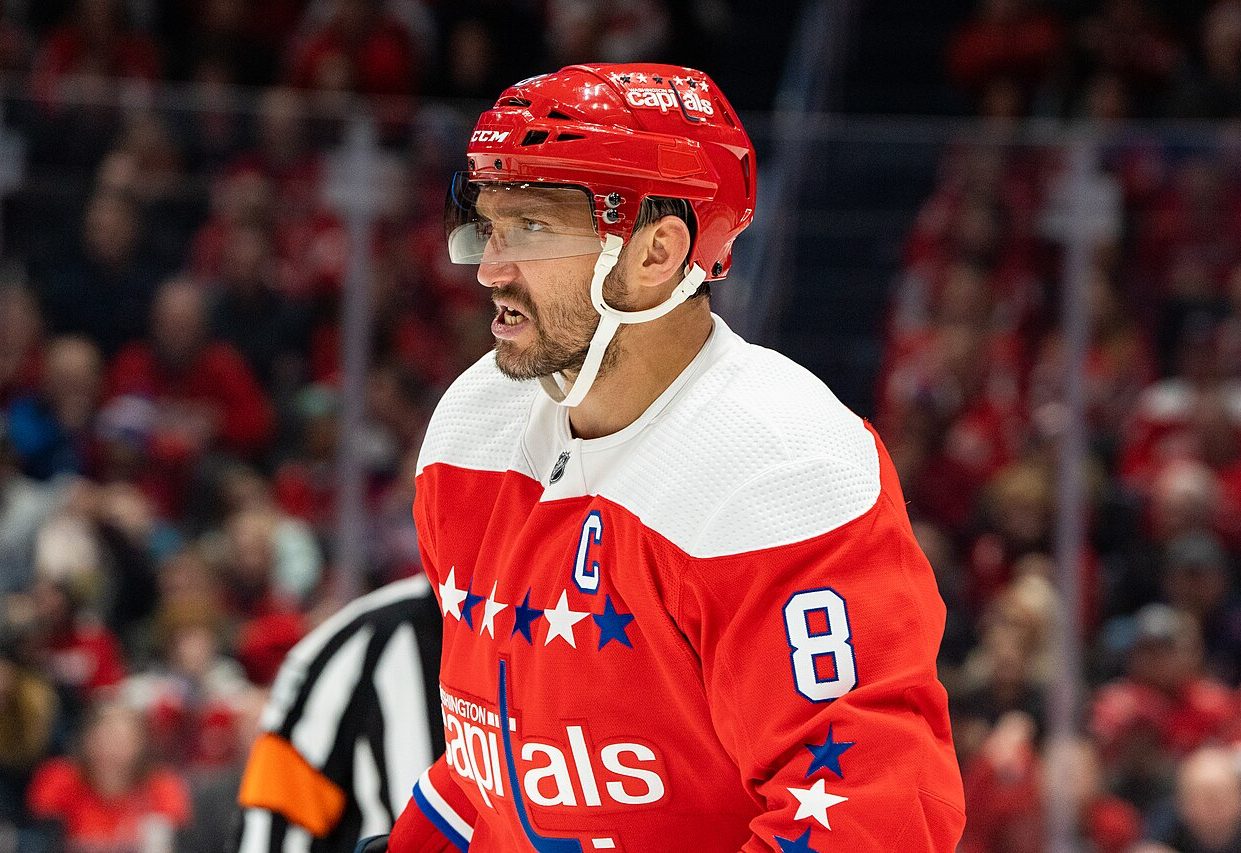
His public identity has stretched between Moscow and the Washington area. On the ice, the constant has been simpler: No. 8, a right-handed stick and a shot opponents spent years trying to take away.
FAQ
Where is Alexander Ovechkin from?
He was born in Moscow, then part of the Soviet Union, on September 17, 1985. He developed through Dynamo Moscow’s hockey system.
What team has Alex Ovechkin played for in the NHL?
Washington is his only NHL franchise. The Capitals drafted him first overall in 2004, and he debuted in October 2005.
When did he break Wayne Gretzky’s goal record?
On April 6, 2025, he scored his 895th regular-season goal against the New York Islanders, passing Gretzky’s 894.
How many Stanley Cups has he won?
He won the Stanley Cup with Washington in 2018 and received the Conn Smythe Trophy as playoff MVP.
Who is Alexander Ovechkin’s wife?
He married Anastasia Shubskaya in 2016. They have two sons, Sergei and Ilya.
Why is the left faceoff circle called “Ovi’s office”?
It is his signature shooting position, particularly on the power play, where his right-handed one-timer became a defining feature of Washington’s attack.
Photo: All-Pro Reels from District of Columbia, USA, CC BY-SA 2.0, via Wikimedia Commons