Wayne Douglas Gretzky was born on January 26, 1961, in Brantford, Ontario. His father, Walter Gretzky, famously built a backyard rink, and that patch of ice became the setting for one of hockey’s most repeated origin stories. It matters because so much of Gretzky’s game was formed there: hours of repetition, a feel for angles, and a habit of seeing the rink as a map rather than a blur.
He stood out almost immediately in youth hockey. As a 10-year-old playing peewee in Brantford, he scored 378 goals and 139 assists in 85 games, a total that drew national attention and, at times, unwanted pressure. He often played against older competition, and even then the pattern was clear. He was not overpowering opponents physically; he was arriving at the right place before anyone else understood why.
One small detail from those years stayed with him. Gretzky tucked one side of his jersey into his pants because his sweaters were too large when he was young. What began as a practical fix turned into a signature look.
Junior hockey and an early jump to the pros
His route to the top was not a straight line through the usual Canadian junior path. Gretzky played briefly for the Peterborough Petes in 1977-78 before joining the Sault Ste. Marie Greyhounds, where his scoring and playmaking quickly made him the focal point of the team.
Before that, he had already made noise internationally. At the 1978 World Junior Championship, as a 16-year-old playing against older competition, he led the tournament in scoring with 17 points in 6 games. It was one of the first times a wider audience saw what made him different: the patience, the timing, and the sense that he was reading the next play a second early.
Because he signed in the WHA, Gretzky never went through the NHL draft in the standard way. In 1978, he joined the Indianapolis Racers on a personal services contract reported at 10 years and $1.75 million. The stay was brief. He played 8 games for Indianapolis before owner Nelson Skalbania sold his contract to Peter Pocklington, moving Gretzky to the Edmonton Oilers.
That season, 1978-79, he had 46 goals and 64 assists for 110 points in 80 WHA games and won the Lou Kaplan Trophy as the league’s rookie of the year. When the WHA folded and Edmonton entered the NHL for 1979-80, Gretzky’s real stage arrived with him.
Edmonton: the rise of a dynasty
The first NHL season offered a preview. Gretzky scored 51 goals and added 86 assists for 137 points in 79 games, tying Marcel Dionne for the league lead in points. Because Dionne had more goals, he won the Art Ross Trophy, but Gretzky took the Hart Trophy as league MVP. It was the start of an awards run the NHL had never really seen.
From 1979-80 through 1987-88 with the Oilers, he played 696 regular-season games and produced 583 goals, 1,086 assists and 1,669 points. Those numbers alone would define most Hall of Fame careers. For Gretzky, they were just the Edmonton chapter.
The trophy list from those years still looks almost unreal, but it is factual enough without embellishment. He won the Hart Trophy eight straight times from 1980 through 1987, then won it again in 1989 with Los Angeles for a total of nine. He captured 10 Art Ross Trophies overall: 1981 through 1987, then 1990, 1991 and 1994. He also won five Lady Byng Trophies and five Lester B. Pearson Awards, now known as the Ted Lindsay Award.
Then there were the scoring peaks. Gretzky remains the only NHL player to record more than 200 points in a season, and he did it four times. His single-season record of 92 goals came in 1981-82. In 1985-86, he set marks for assists in a season with 163 and points in a season with 215.
Four Stanley Cups in Edmonton
Great regular-season numbers are one thing. The Oilers became champions when the roster around Gretzky matured into a powerhouse. With Mark Messier, Jari Kurri, Paul Coffey, Glenn Anderson, Grant Fuhr and others, Edmonton won the Stanley Cup in 1984, 1985, 1987 and 1988.
Gretzky won the Conn Smythe Trophy as playoff MVP twice, in 1985 and 1988. By then, his style had become so recognizable that one area of the rink took his name. “Gretzky’s office,” behind the net, was where he slowed the game down, drew defenders out of shape and picked apart coverage with passes that seemed obvious only after they arrived.
That was the essence of his greatness as a center. Plenty of players skated faster or hit harder. Gretzky controlled games with anticipation, touch and spatial awareness. He understood where teammates were headed and where defenders were vulnerable. The assist total tells that story as clearly as the goal total does.
The trade that changed hockey in Los Angeles
On August 9, 1988, the Oilers traded Gretzky to the Los Angeles Kings in one of the most famous deals in sports history. The move stunned Canada and transformed the Kings overnight. It also helped change the NHL’s profile in the American Sun Belt, especially in Southern California, where hockey suddenly had a headline star.
Gretzky’s play did not fall off in Los Angeles. From 1988-89 through most of 1995-96, he played 539 games for the Kings and recorded 246 goals, 672 assists and 918 points. In his first season there, he won another Hart Trophy. He also added Art Ross titles in 1990, 1991 and 1994.
The Kings reached the Stanley Cup Final in 1993, the high point of his Los Angeles years, though they lost to the Montreal Canadiens. Even without a championship there, his impact on the franchise and the market was lasting. Youth participation grew, interest in the sport widened, and the image of elite hockey no longer felt confined to traditional northern markets.
St. Louis and the final Rangers chapter
Late in the 1995-96 season, Los Angeles traded Gretzky to the St. Louis Blues. He played 18 regular-season games there, scoring 8 goals and 13 assists for 21 points. The stay was short and productive, but it never became a long-term fit.
He signed with the New York Rangers ahead of the 1996-97 season and spent his final three NHL years there, reuniting with Mark Messier. In 234 games for the Rangers, he posted 67 goals and 161 assists for 228 points. The numbers were lower than in his peak years, naturally, but the playmaking remained. He still saw seams others missed, still managed pace, still made offense feel organized.
Gretzky retired after the 1998-99 season. His final NHL game came on April 18, 1999.
When he left, the career totals stood at 1,487 regular-season games, 894 goals, 1,963 assists and 2,857 points. He retired holding 61 NHL records, including 40 in the regular season, 15 in the playoffs and 6 in All-Star competition. Most famously, he finished with more assists than any other player has total points.
International hockey and honors
His international resume was not as long as his NHL one, but it still carried weight. Gretzky played for Canada in the Canada Cup in 1984, 1987 and 1991, helping win the tournament in 1984 and 1987. He also represented Canada at the 1998 Nagano Olympics.
Later, he moved into team leadership off the ice. Gretzky served as executive director of Canada’s men’s hockey team for the 2002 Salt Lake City Olympics, where Canada won gold. He was also one of the most visible figures at the Vancouver 2010 Olympics, serving as the final torchbearer.
The Hockey Hall of Fame waived its waiting period and inducted him in 1999. The IIHF Hall of Fame followed in 2000. On February 6, 2000, the NHL retired No. 99 league-wide, a singular honor that underlined his place in the sport.
How Wayne Gretzky played
Any Wayne Gretzky biography eventually comes back to the same question: how did he dominate so completely without relying on brute force? The answer sits in the details of his game.
He processed the rink unusually fast. He drifted into quiet ice, held pucks a beat longer than defenders wanted, and passed not to where a teammate was, but to where the play was about to open. He could score, obviously, but his game was built around orchestration. He turned possessions into patterns and defenders into guessers.
That is why the assist record may be the clearest measure of his style. The goals matter. The vision explains the rest.
Off the ice: family, business and public life
Away from hockey, Gretzky has long had a public-facing life that extends beyond the rink. He married actress Janet Jones in 1988, and they have five children: Paulina, Ty, Trevor, Tristan and Emma. Because his family has been visible for decades, it often becomes part of his profile, but the basic facts are straightforward and well established.
His post-playing career has included ownership, coaching, business and broadcasting. Gretzky was a part-owner of the Phoenix Coyotes and served as the team’s head coach from 2005 to 2009. He later worked with Oilers Entertainment Group as vice-chairman and partner. In television, he became a studio analyst for TNT’s NHL coverage.
He has also lent his name to business ventures, including Wayne Gretzky Estates. Endorsements have been part of his public image for years as well, though exact earnings estimates vary by source and are best treated cautiously unless tied to specific reporting.
A few side claims that circulate online deserve careful labeling. Reports about possible ownership discussions involving other NHL clubs in the past have surfaced from time to time, but unless tied to primary reporting, they remain just that: reports. The same goes for repeated discussions of deeper family ancestry beyond what Gretzky and his family have publicly stated. Those claims are often based on secondary or user-generated sources and should be treated as unconfirmed.
His charitable work is better documented. The Wayne Gretzky Foundation has supported youth access to hockey, and he has also been associated with Right To Play in an honorary role.
FAQ
How many Stanley Cups did Wayne Gretzky win?
Wayne Gretzky won 4 Stanley Cups, all with the Edmonton Oilers: 1984, 1985, 1987 and 1988.
When did Wayne Gretzky retire?
He retired from the NHL after the 1998-99 season. His final game was on April 18, 1999.
What records does Wayne Gretzky still hold?
He still holds the NHL records for career points with 2,857 and career assists with 1,963, among many others.
Which teams did Wayne Gretzky play for?
He played for the Edmonton Oilers, Los Angeles Kings, St. Louis Blues and New York Rangers in the NHL, plus the Indianapolis Racers and Oilers in the WHA.
Why is No. 99 so famous in hockey?
Because of Gretzky’s career and influence, the NHL retired No. 99 across the entire league in 2000.
Who is Wayne Gretzky married to?
He is married to Janet Jones. They married in 1988.
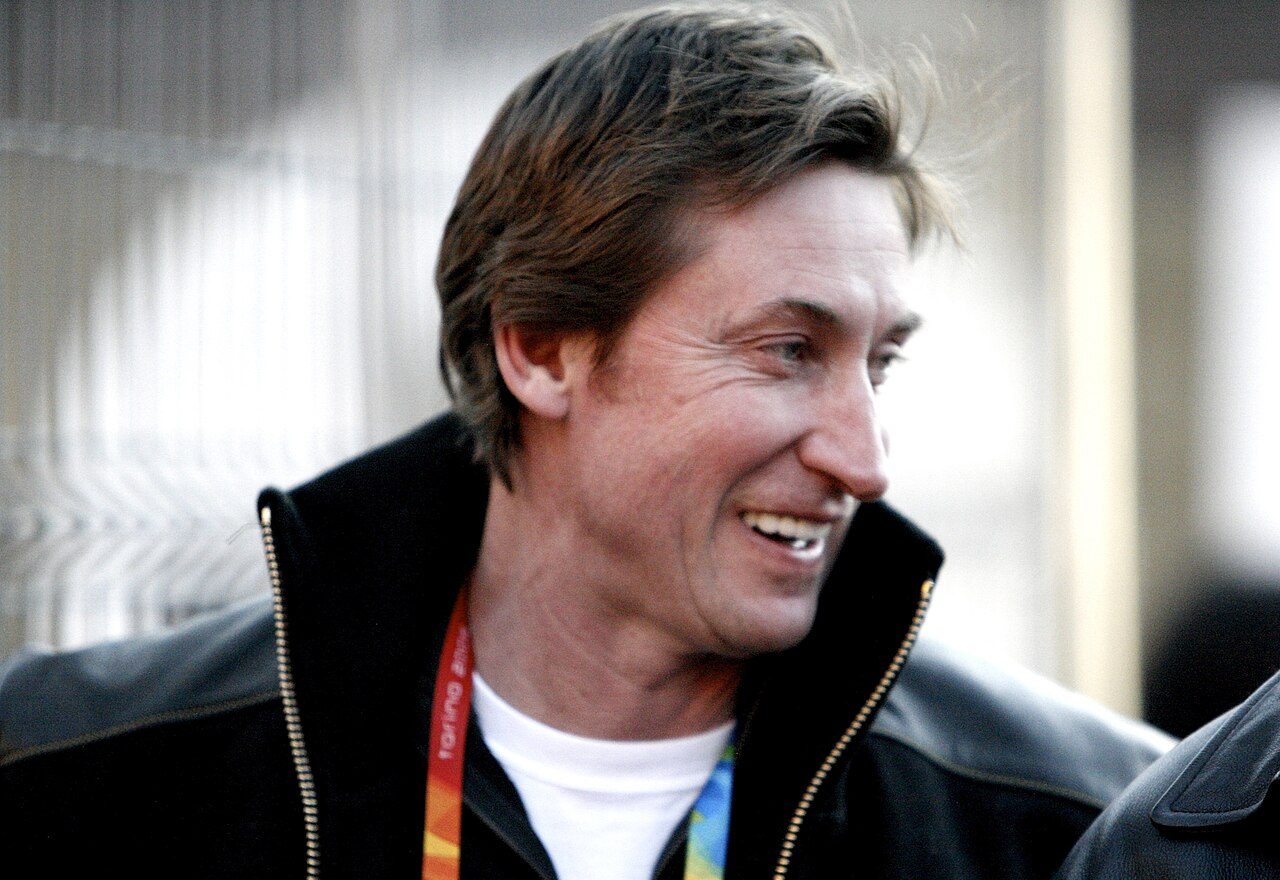
Photo: Kris Krüg, CC BY-SA 2.0, via Wikimedia Commons