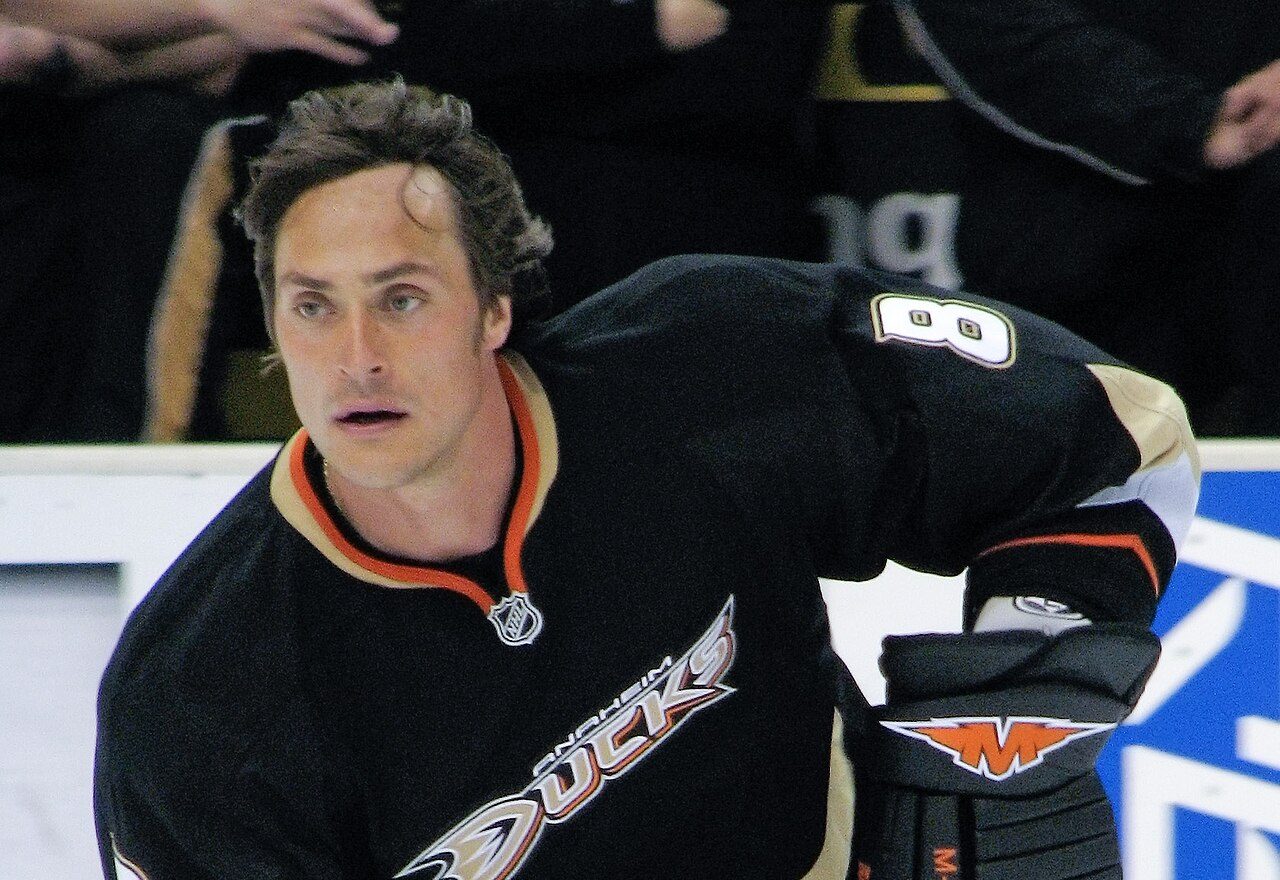
Seventy-six goals. As rookie numbers go, that one still stops people.
Teemu Selanne arrived in the NHL with a season so explosive that it has never really faded into history. In 1992-93, the Finnish right wing scored 76 goals and 132 points for the Winnipeg Jets, setting rookie records in both categories. He left the league more than two decades later with 684 goals, 1,457 points, a Stanley Cup ring in Anaheim, and a place at the top of Finland’s NHL scoring list.
Teemu Selanne profile
- Position: Right wing
- Shoots: Right
- Height: 6 ft 0 in (183 cm)
- Weight: 209 lb (95 kg)
- Born: July 3, 1970
- Birthplace: Helsinki, Finland
- Nationality: Finnish
- Jersey number: No. 8
From Helsinki to Jokerit
Long before he became the Finnish Flash, Selanne was a gifted young player coming through Jokerit’s system in Helsinki. He was part of the club’s junior success in the late 1980s, including a Finnish Junior A championship in 1987-88, and his route to stardom had a few detours that made it less straightforward than his later NHL rise might suggest.
Before leaving for North America, he completed Finland’s mandatory military service and also studied business. That matters because Selanne did not arrive in the NHL as a teenage mystery prospect. By the time he crossed the Atlantic, he had already spent real time in men’s hockey and looked physically and mentally ready for it.
The Winnipeg Jets had seen enough to draft him 10th overall in the 1988 NHL Entry Draft. Selanne stayed in Finland for several more seasons, playing for Jokerit in both 1. Divisioona and SM-liiga from 1988 to 1992. His big domestic breakthrough came in 1991-92, when he scored 39 goals and 62 points in 44 games. He won the Aarne Honkavaara Trophy as the league’s top goal scorer that season, after taking the Raimo Kilpio Trophy in 1991.
By then, the outline of his game was already clear: speed first, then the release, then the knack for turning a half-chance into a goal.
Winnipeg and the rookie season that still stands
Some players need a year to adjust to NHL pace. Selanne treated the league like a runway.
He joined the Jets for the 1992-93 season and immediately produced one of the great debuts in hockey history: 76 goals, 56 assists and 132 points in 84 games. Those remain the NHL rookie records for goals and points. He won the Calder Memorial Trophy and was named to the NHL First All-Star Team.
What made that season memorable was not just the total. It was the way he scored. Selanne could blow past defenders in open ice, attack off the rush, or finish quickly when the puck found him in traffic. He had the stride of a breakaway threat and the hands of a pure finisher. The nickname “The Finnish Flash” fit because his game often looked exactly like that: a blur, then a goal.
He stayed in Winnipeg through part of the 1995-96 season. In 231 games with the franchise, he scored 147 goals and 306 points. He also became the second-fastest player in NHL history at the time to reach 100 goals, getting there in 130 games. For a club that had drafted him years earlier and waited, the payoff was immediate and dramatic.
Anaheim becomes the main chapter
In February 1996, the Jets traded Selanne to the Mighty Ducks of Anaheim. The move gave him a new stage, and eventually it gave the franchise one of its defining players.
His first stretch in Anaheim, from 1995-96 through 2000-01, was hugely productive. He scored 245 goals and 502 points in 394 games during that span and became one of the league’s most dangerous wingers. He was named to the NHL First All-Star Team in 1996-97 and to the Second All-Star Team in each of the next two seasons.
The late 1990s brought more hardware. Selanne was the MVP of the 1998 NHL All-Star Game, becoming the first European-born player to win that award. In 1998-99, he shared the Maurice “Rocket” Richard Trophy as the NHL’s leading goal scorer with 47 goals, tied with Washington’s Alexander Ovechkin? No, that would be years later. The tie was with Pittsburgh’s Jaromir Jagr, so that point needs to stay accurate: Selanne and Jagr shared the award in 1998-99, the first season the trophy was formally presented.
Anaheim was where his identity as an NHL star fully settled in. Winnipeg gave him the unforgettable entrance. Anaheim gave him the long runway.
Stops in San Jose and Colorado, then a return
After the 2000-01 season, Anaheim traded Selanne to the San Jose Sharks. His two seasons there were productive by normal standards, though not at the same level as his best years with the Ducks. He scored 64 goals and 157 points in 162 games for San Jose from 2001 to 2003.
The original version of this biography mentioned an “unspecified controversy” with the Sharks in 2002-03. Without a clear, sourced and relevant fact to support that claim, it is better left out. What is well documented is that this period was less smooth, and that injuries soon became a major part of the story.
Selanne signed with the Colorado Avalanche for 2003-04, but the season never clicked. He played through significant knee trouble, scored 16 goals in 78 games, and later underwent surgery. The lost sharpness was noticeable because his game had always depended so heavily on acceleration and edge work.
Then came the reset.
Because of the 2004-05 NHL lockout, Selanne had extra time to recover. He returned to Anaheim in 2005-06 and looked rejuvenated, scoring 40 goals and 90 points at age 35. He won the Bill Masterton Memorial Trophy that season, an award that fit the comeback story better than any dramatic language could.
One small detail from that return stands out. Since No. 8 was being worn by Sandis Ozolinsh when Selanne first came back, he opened the season in No. 13 before switching back to his familiar number after Ozolinsh was traded.
The Stanley Cup season and the late-career finish
For all the goals and awards, one major team prize had been missing. Selanne got it in 2007.
He signed a one-year deal before the 2006-07 season and helped Anaheim win the Stanley Cup, the only championship of his NHL career. He was no longer the young winger who could simply outrun everyone every shift, but he remained a dangerous scorer and a key veteran presence on a deep Ducks team.
He stayed with Anaheim through 2013-14, carefully weighing retirement more than once before deciding to return. By the time he played his final NHL game, he had appeared in 1,451 regular-season games and had become inseparable from Ducks history.
His final Anaheim totals are the numbers that explain the bond: 457 goals, 531 assists, 988 points and 966 games, all franchise records when he retired. The Ducks retired his No. 8 in January 2015.
Teemu Selanne stats and place in history
Selanne finished his NHL career with:
- 1,451 regular-season games
- 684 goals
- 773 assists
- 1,457 points
- 130 playoff games
- 44 playoff goals
- 44 playoff assists
- 88 playoff points
He remains the highest-scoring Finnish-born player in NHL history in both goals and points. He is also one of the few players ever to score 70 goals in a season, thanks to that 76-goal rookie year.
His career shooting percentage, 15.1, reflects what he was: not just a volume shooter, but an efficient finisher. And his longevity mattered almost as much as his peak. Selanne was still contributing well into his 40s, adjusting his game as his speed naturally changed, relying more on timing, positioning and touch.
Finland, the Olympics and an international legacy
If the NHL made Selanne famous, international hockey made him something even bigger in Finland.
He represented his country across an unusually long span, playing in six Olympics, five World Championships, and three Canada Cup/World Cup tournaments. His medal collection is substantial: Olympic silver in 2006, Olympic bronze in 1998, 2010 and 2014, World Championship silver in 1999, and World Championship bronze in 2008.
The Olympic record is the headline. Selanne is the all-time leading scorer in men’s Olympic hockey with 43 points. At the 2006 Turin Games, he was named Best Forward. At the 2014 Sochi Olympics, he was named tournament MVP after helping Finland win bronze at age 43.
That late Olympic run felt like a fitting final act: one more reminder that his game, and his sense for big moments, lasted longer than most.
Finland later retired his No. 8 at the national-team level. It was another sign of how fully he belonged to the country’s hockey story.
What made his game work
Speed was always the first problem for defenders. Selanne could separate in open ice, attack wide, and force mistakes simply by making opponents turn and chase. But reducing him to straight-line pace misses part of the picture.
He was also a smart scorer. He read space well, found soft spots in coverage, and released the puck quickly enough to beat goaltenders before they were set. His right-handed shot was dangerous off the rush and on the power play, and he remained a threat even after injuries took away some of the burst that defined his younger years.
At his best, he was one of those wingers who changed the feel of a game. A loose puck or a clean outlet pass could become a breakaway in a second.
Off the ice: family, business and public life
Away from hockey, Selanne built a public image that was warmer and more relaxed than the standard star-athlete profile. He has long been known as approachable and upbeat, and that reputation carried across both Finland and Southern California.
He is married to Sirpa Selanne, née Vuorinen, and they have four children. Earlier versions of this biography listed only three sons; that was incomplete. The family spent much of his later playing career in Orange County, where Selanne became closely associated with the Ducks community.
His business interests have included real estate and hospitality. He has also been involved with Selanne Steak Tavern in Laguna Beach, a high-profile restaurant that became part of his post-playing identity in California. Some other business claims that circulate online are unevenly sourced or too loosely documented to present here as settled fact.
Charity has been a visible part of his public profile as well, with support for youth sports and children’s causes in both Finland and North America. Those efforts have often matched the image he carried as a player: famous, certainly, but rarely distant.
A political note sometimes appears in online summaries of Selanne’s life. Any claim about party support should be treated carefully unless directly sourced to Selanne or a reliable published report. Without that, it is better not to state it as fact.
He was also the subject of the documentary Sel8nne, released in Finland in 2013.
Awards, honors and Hall of Fame recognition
The awards list is long, but the key pieces tell the story cleanly.
In the NHL, Selanne won the Calder Trophy in 1993, shared the Rocket Richard Trophy in 1999, won the Bill Masterton Trophy in 2006, and earned NHL All-Star Game MVP honors in 1998. He was named to the NHL First All-Star Team in 1993 and 1997, and to the Second All-Star Team in 1998 and 1999.
In Finland, he was repeatedly recognized as the country’s top hockey player and had already collected major domestic honors before his NHL breakthrough.
In 2017, he was inducted into the Hockey Hall of Fame. He was also inducted into the IIHF Hall of Fame and the Finnish Hockey Hall of Fame, and named one of the NHL’s 100 Greatest Players.
That combination fits the shape of his career. Selanne was not just a brilliant rookie or a popular veteran. He was both, with a long middle in between.
FAQ
When did Teemu Selanne retire?
He retired from the NHL after the 2013-14 season.
How many goals did Teemu Selanne score?
He scored 684 goals in the NHL regular season.
Did Teemu Selanne win a Stanley Cup?
Yes. He won one Stanley Cup with the Anaheim Ducks in 2007.
What is Teemu Selanne’s rookie record?
He holds the NHL rookie records for goals (76) and points (132), both set in 1992-93.
What teams did Teemu Selanne play for?
He played for Jokerit in Finland, then in the NHL for the Winnipeg Jets, Mighty Ducks of Anaheim/Anaheim Ducks, San Jose Sharks and Colorado Avalanche.
Why is Teemu Selanne called the Finnish Flash?
The nickname reflects his speed, explosive skating and quick-strike scoring style.
Photo: mark6mauno, CC BY 2.0, via Wikimedia Commons