On June 9, 2010, Brian Campbell sent the puck to Patrick Kane in overtime and watched the Chicago winger carry it toward the Philadelphia net. Kane’s shot slipped past Michael Leighton, ending the Stanley Cup Final. Campbell had the primary assist on the goal that delivered Chicago’s first championship since 1961.
It was an appropriate place for him on the scoresheet. Over 1,082 NHL games, the Canadian defenceman made his living moving the puck: escaping pressure, finding a passing lane and putting teammates in position to attack. His career took him through four franchises, a season in Finland and two spells in Chicago before his retirement on July 17, 2017.
From Strathroy to a Memorial Cup in Ottawa
Born on May 23, 1979, in Strathroy, Ontario, Brian Wesley Campbell developed through southwestern Ontario’s minor-hockey system. He played for the Elgin-Middlesex Chiefs before joining the Petrolia Jets for the 1994-95 Junior B season.
The next step took him to the Ottawa 67’s. Beginning in 1995, the left-shot defenceman spent four seasons learning how to turn his skating and puck skills into an offensive weapon at the Ontario Hockey League level.
At a listed 5-foot-10 and 190 pounds, he was not built to dominate through reach or sheer size. Mobility gave him another route. He could change direction, carry possession out of trouble and get the puck moving before a forechecker closed the gap.
Buffalo selected him 156th overall in the sixth round of the 1997 NHL Entry Draft. His most decorated junior season was still ahead.
In 1999, Campbell won the Red Tilson Trophy as the OHL’s most outstanding player, the Max Kaminsky Trophy as its top defenceman and the William Hanley Trophy as its most gentlemanly player. He was also named CHL Player of the Year.
The team success matched the individual awards. Ottawa won the 1999 Memorial Cup on home ice, beating the Calgary Hitmen in overtime in the final. Earlier that year, Campbell had helped Canada earn silver at the World Junior Championship.
Earning his place in Buffalo
Campbell made his NHL debut with the Sabres during the 1999-2000 season, but becoming an established NHL defenceman took longer. His early professional years included considerable time with Buffalo’s American Hockey League affiliate, the Rochester Americans.
That apprenticeship matters to his story. A sixth-round selection did not arrive with a guaranteed place, and his eventual standing as an All-Star came after several seasons of working toward regular NHL employment.
When the lockout shut down the 2004-05 NHL season, he joined Jokerit in Finland. He scored 12 goals and added 13 assists in 44 regular-season games, helping the Helsinki club reach the Finnish league final.
Back in Buffalo, his offensive contribution grew. He recorded 44 points in 2005-06, then 48 the following season as the Sabres won the Presidents’ Trophy.
He also showed that a smaller puck-moving defenceman could deliver a hard open-ice hit. His collision with Philadelphia’s R.J. Umberger during the 2006 playoffs became one of the most replayed moments of that postseason.
All-Star Game appearances followed in 2007 and 2008. Under Buffalo’s rotating leadership system, he served as an alternate captain in November 2007 and captain that December.
A deadline move and an 83-game season
On February 26, 2008, Buffalo traded Campbell to the San Jose Sharks in a deal that brought forward Steve Bernier and a first-round draft pick to the Sabres.
He settled quickly into San Jose’s attack, producing three goals and 16 assists in 20 regular-season games. Combined with his 63 appearances for Buffalo, that gave him an unusual total: 83 games in an 82-game season. The teams’ different schedules made the extra appearance possible.
Across both clubs, he finished with 62 points, his NHL career high. Selection to the 2008 NHL Second All-Star Team recognized his place among the league’s leading defencemen that season.
San Jose was a short stop. On July 1, 2008, Campbell signed an eight-year contract with Chicago, widely reported at approximately $7.1 million per season.
The Blackhawks were building around a young core. His skating and passing gave them an experienced option on the blue line as that group moved into contention.
Chicago: a broken collarbone, then the Cup
Campbell contributed 52 points in his first Chicago season and made another All-Star Game appearance in 2009. The Blackhawks reached the Western Conference Final, setting up a deeper run the following spring.
That championship season nearly ended early for him.
On March 14, 2010, a boarding hit by Washington’s Alex Ovechkin left Campbell with a broken collarbone and a fractured rib. The NHL suspended Ovechkin for two games. For Campbell, the injury ended a streak of 388 consecutive regular-season appearances.
He returned during the first round of the playoffs against Nashville. By the Stanley Cup Final, he was again helping Chicago move the puck through pressure.
His pass to Kane in Game 6 became his most consequential NHL assist. The finish was so difficult to see that celebration initially gave way to confusion, but the result was clear: Chicago had won the Cup.
Across his first three seasons with the Blackhawks, Campbell recorded 117 points in 215 regular-season games.
Florida and a rare award for a defenceman
On June 24, 2011, Chicago traded Campbell to the Florida Panthers for forward Rostislav Olesz. The move reunited him with Dale Tallon, the Panthers executive who had previously helped bring him to Chicago.
Florida gave him a major workload. In 2011-12, he played all 82 games, recorded 53 points and helped the Panthers win the Southeast Division, ending a playoff absence that had stretched back to 2000.
He took just six penalty minutes.
That combination of production and discipline earned him the 2012 Lady Byng Memorial Trophy. He was the first defenceman to win the award since Detroit’s Red Kelly in 1954, an unusually long gap for an honor open to players at every position.
Campbell also made his fourth NHL All-Star Game appearance that season. In 2013, he represented Canada at the senior World Championship.
Over five seasons in Florida, he played 376 regular-season games and contributed 28 goals and 147 assists. He appeared in every Panthers regular-season game during that stretch, including the lockout-shortened 2012-13 campaign.
One last season in Chicago
Campbell returned to the Blackhawks as a free agent on July 1, 2016, signing a one-year contract. He played 80 games in 2016-17 and finished with five goals and 12 assists.
When he announced his retirement on July 17, 2017, his regular-season totals stood at 87 goals, 417 assists and 504 points in 1,082 games.
The numbers describe a distributor more than a shooter. His best work often came before the obvious scoring chance: a turn away from pressure, a controlled exit or a pass that allowed a forward to enter the offensive zone with speed.
He could contribute on the power play without making every possession complicated. Skating created space; his passing put that space to use.
“Soupy” away from the rink
The nickname “Soupy,” a straightforward nod to Campbell’s surname, followed him throughout his career.
Contemporary coverage reported that he became engaged to Lauren Miller during the 2011 NHL All-Star break. Chicago remained an important personal base during his Florida years, helping explain why the eventual return was about more than familiarity with the dressing room.
One of the stranger interruptions to his playing life came in Buffalo in 2003, when he underwent quarantine following possible exposure to SARS. It was a public-health precaution, not a confirmed diagnosis of the illness.
Retirement did not take him far from hockey. The Blackhawks announced that he would join their business operations department, with work involving marketing, community relations and youth hockey initiatives.
Ottawa also marked his contribution to the sport. On November 3, 2017, the 67’s retired his No. 44, honoring the defenceman who had helped bring a Memorial Cup to the city before building a long NHL career.
FAQ
Where was Brian Campbell born?
He was born in Strathroy, Ontario, Canada, on May 23, 1979.
Which NHL teams did he play for?
He played for the Buffalo Sabres, San Jose Sharks, Chicago Blackhawks and Florida Panthers, with two separate spells in Chicago.
Did he win the Stanley Cup?
Yes. He won with Chicago in 2010 and provided the primary assist on Patrick Kane’s Cup-winning overtime goal.
What were his career NHL statistics?
Campbell finished with 87 goals and 417 assists for 504 points in 1,082 regular-season games.
Why did he win the Lady Byng Trophy?
He combined a 53-point season with just six penalty minutes in 2011-12, earning the award for sportsmanship and a high standard of play.
What did he do after retiring?
He joined the Blackhawks’ business operations department, contributing to marketing, community relations and youth hockey work.
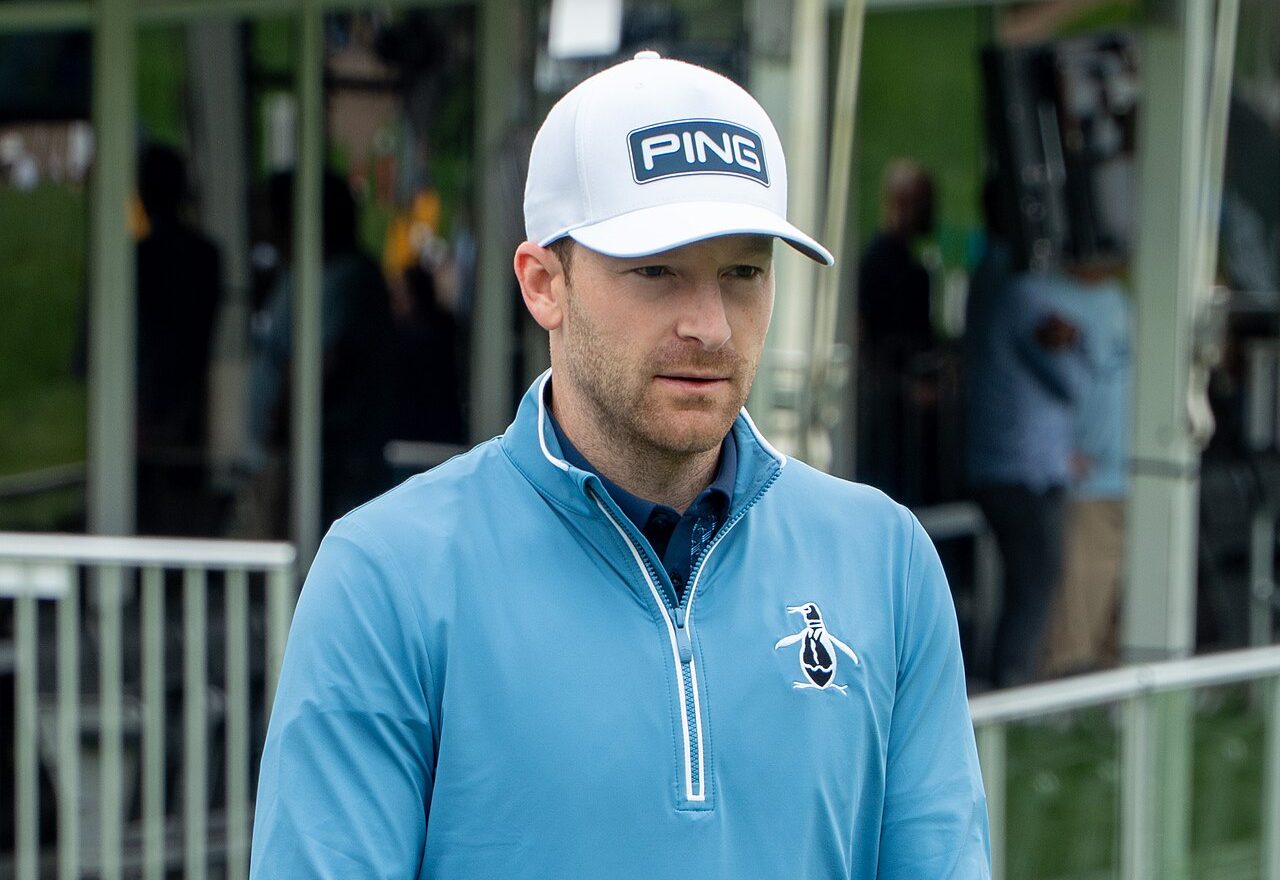
Photo: Bryan Berlin, CC BY-SA 4.0, via Wikimedia Commons