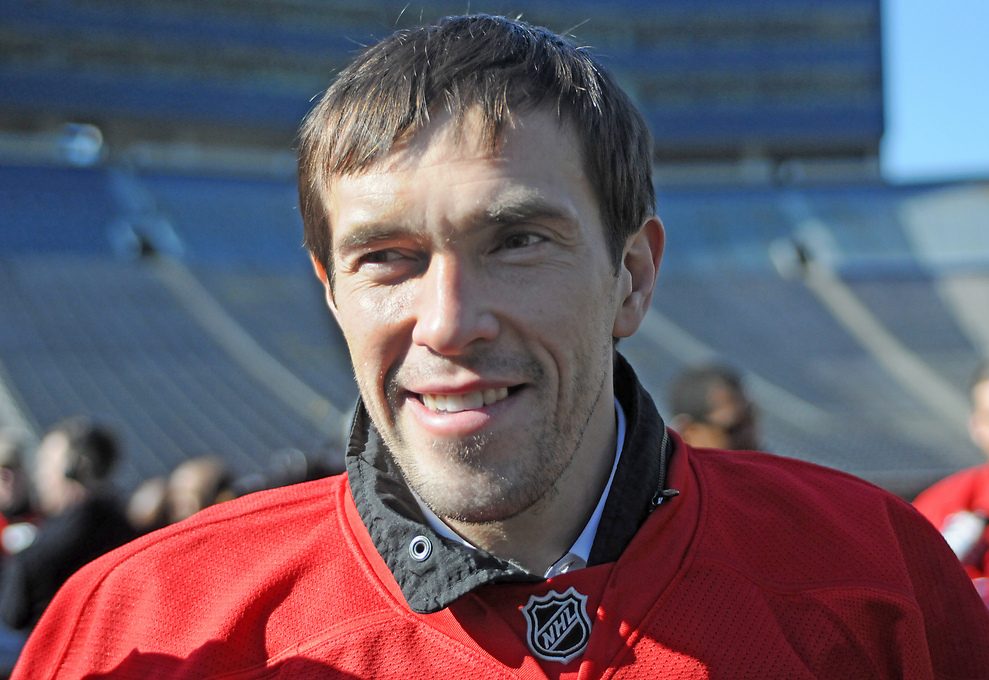
Pick No. 171 rarely turns into a franchise touchstone. Pavel Datsyuk did.
Long before his surname became shorthand for impossible hands and stolen pucks, Datsyuk was a slight kid from Sverdlovsk playing in borrowed skates. He was born on July 20, 1978, in the Soviet city now known as Yekaterinburg, and his route to the NHL was anything but obvious. He did not arrive with the draft hype of a top prospect. He came up through local hockey, was easy to overlook physically, and kept moving anyway.
That background matters because it shaped the player Detroit eventually got: patient, subtle, hard to read, and relentlessly detailed. By the time his career ended, he had won two Stanley Cups with the Detroit Red Wings, built one of the best defensive resumes by a modern center, and left behind a style so distinctive that “Datsyukian” entered hockey language.
Growing up in Yekaterinburg
Datsyuk began playing hockey as a child in Sverdlovsk, reportedly starting out in skates handed down from his sister. He developed in the Yekaterinburg system and reached senior hockey unusually young, appearing in Russia’s top domestic structure as a teenager.
His early club path ran through Spartak Yekaterinburg and Dynamo-Energiya Yekaterinburg before a move to Ak Bars Kazan. Those years did not make him famous outside Russia, but they put him in front of the right scout at the right moment. The well-known story is that Red Wings scout Hakan Andersson caught a closer look at Datsyuk partly because weather disrupted other travel plans. However it happened, Detroit saw what others missed.
There was hardship in those years too. Datsyuk lost his mother, Galina, when he was still a teenager. His father, Valeri, died later during Datsyuk’s professional career. Those losses are part of his story, though he generally kept his private life private and let the hockey speak for him.
Drafted late, then off to Detroit
The Red Wings selected Datsyuk in the sixth round of the 1998 NHL Draft. He was the 171st overall pick, a number that still stands out because of what came after it.
He stayed in Russia for a few more seasons, including time with Ak Bars Kazan, before joining Detroit for the 2001-02 season. That timing dropped him into a veteran-heavy Red Wings team loaded with Hall of Fame talent. It could have been easy for a young center to get lost in that room. Instead, he found a role quickly.
As a rookie, he played 70 games and posted 35 points. More important than the raw total was the fit. Detroit already had stars; what Datsyuk added was a different kind of control. He could slow a play down, win pucks back, and create offense from spots that looked closed off to everyone else. The Red Wings won the Stanley Cup that spring, giving him a title in his first NHL season.
The Red Wings years: skill, steals and complete hockey
From 2001 to 2016, Detroit was his only NHL team. Over 953 regular-season games, Datsyuk recorded 314 goals, 604 assists and 918 points, finishing with a plus-249 rating. Those are elite numbers, but they still do not quite capture what made him such a singular player.
He was a center who could embarrass defenders one shift and strip a star forward on the backcheck the next. His hands got the attention. His defensive detail won coaches over. He became one of the league’s best takeaway artists, reading routes early and lifting sticks without taking himself out of position.
That balance defined his prime. Datsyuk was not just productive; he drove possession, killed plays before they developed, and made difficult touches look casual. The nickname “Magic Man” stuck because the puck seemed to follow his imagination. But the magic was built on structure as much as flair.
Detroit leaned on him heavily as the roster evolved after its early-2000s peak. During the 2004-05 NHL lockout, he returned to Russia and played for Dynamo Moscow. During the 2012-13 lockout, he spent time with CSKA Moscow. In between, he remained central to the Red Wings’ identity.
The high point of that middle stretch came in 2007-08. Detroit won another Stanley Cup, and Datsyuk completed one of the most decorated individual seasons of his career. He won the Selke Trophy as the NHL’s top defensive forward, the Lady Byng Trophy for skill and sportsmanship, and the NHL Plus-Minus Award. Then he repeated as Selke and Lady Byng winner in 2008-09, and took a third straight Selke in 2009-10.
His major NHL awards stack up this way:
- Stanley Cup champion: 2002, 2008
- Frank J. Selke Trophy: 2008, 2009, 2010
- Lady Byng Memorial Trophy: 2006, 2007, 2008, 2009
- NHL Plus-Minus Award: 2008
That is a rare combination. Plenty of top-line centers score. Very few score like a first-line player while defending like a specialist.
Detroit also showed its belief in him through a series of contracts, including a seven-year extension signed in 2007 and a three-year deal signed in 2013. By then, he was no longer a hidden gem. He was one of the defining Red Wings of his era.
The style that made “Datsyukian” a real hockey word
Some careers are easiest to explain through totals. Datsyuk’s is easier to remember in clips.
A defender reaches, misses, and is suddenly behind the play. A puck carrier thinks he has time, then feels Datsyuk’s stick take the puck cleanly. A pass slips through traffic into a lane that did not seem open. He created that kind of sequence over and over.
At 5-foot-11, he was never built like a power center. He beat players with edges, timing, body position and touch. He shot left, played mostly down the middle, and could control a shift without dominating it physically. That subtlety is part of why players and coaches admired him so much. He made hard plays look light.
The term “Datsyukian” caught on because there was no simpler way to describe certain moves. It referred to deception, yes, but also to economy. He rarely looked rushed. He rarely looked wasteful.
International career with Russia
Datsyuk’s international résumé is strong enough to stand on its own.
He represented Russia at five Olympics: 2002, 2006, 2010, 2014 and 2018. He won bronze in 2002 and gold in 2018, captaining the Olympic Athletes from Russia team at the Pyeongchang Games. That gold, combined with his Stanley Cup titles and World Championship success, placed him in the Triple Gold Club.
At the IIHF World Championship, he helped Russia win gold in 2012, silver in 2010, and bronze in 2005, 2016 and 2017. He was also named Best Forward by the IIHF Directorate at the 2010 tournament.
What stands out is the span. He was not a one-tournament figure for the national team. He remained relevant internationally across different stages of his career, from his early NHL years to his post-Detroit run.
Back to Russia and the final chapter
After the 2015-16 season, Datsyuk left the NHL and returned home. He signed with SKA Saint Petersburg in the KHL and showed that the hands and vision were still there. In two seasons with SKA, he remained an effective playmaker and a controlled presence in the middle of the ice.
He later moved to Avtomobilist Yekaterinburg, bringing the story back to his home city. For a player whose career had started in local rinks in Sverdlovsk/Yekaterinburg, that ending had a certain symmetry. He officially retired from playing in 2021.
His post-NHL honors continued. He was named to the NHL’s 100 Greatest Players list in 2017, and in 2024 he was inducted into the Hockey Hall of Fame.
Life away from the rink
Off the ice, Datsyuk has generally kept a low public profile. That has not stopped interest in his family life, especially from readers searching for Pavel Datsyuk wife details.
Published reports state that he was married to his first wife, Svetlana, and that they had a daughter, Elizaveta, before divorcing. Reports also state that he later married Maria and that the couple have children together. Because Datsyuk has not made his private life a major public subject, it is best to treat family details with care and stick to information that has been widely reported.
He has also spoken about his Christian faith, and he returned to Russia after his NHL career rather than staying in North America full-time. That choice fit the broader arc of his life: a player who became famous in Detroit but never seemed detached from where he came from.
Why Pavel Datsyuk still stands out
The easiest label is “two-way center,” but that undersells him. Plenty of forwards are responsible. Plenty are creative. Datsyuk was both at an unusually high level, and he blended those parts of the game so smoothly that one fed the other.
His legacy with the Detroit Red Wings rests on more than points. It rests on feel. On puck thefts that changed possession without a collision. On patience under pressure. On the sense that a shift could tilt because he saw a play half a second earlier than everyone else.
A sixth-round pick is not supposed to become a Hall of Famer. Pavel Datsyuk did, and he did it with a game that still feels distinct.
FAQ
When was Pavel Datsyuk born?
Pavel Datsyuk was born on July 20, 1978.
What NHL team did Pavel Datsyuk play for?
He played his entire NHL career with the Detroit Red Wings.
How many Stanley Cups did Pavel Datsyuk win?
He won two Stanley Cups, in 2002 and 2008.
What are Pavel Datsyuk’s NHL career stats?
He finished with 953 NHL games, 314 goals, 604 assists and 918 points.
Did Pavel Datsyuk win Olympic gold?
Yes. He won Olympic gold in 2018 and Olympic bronze in 2002.
Is Pavel Datsyuk in the Hockey Hall of Fame?
Yes. He was inducted into the Hockey Hall of Fame in 2024.
Photo: Adam Glanzman, CC BY 2.0, via Wikimedia Commons