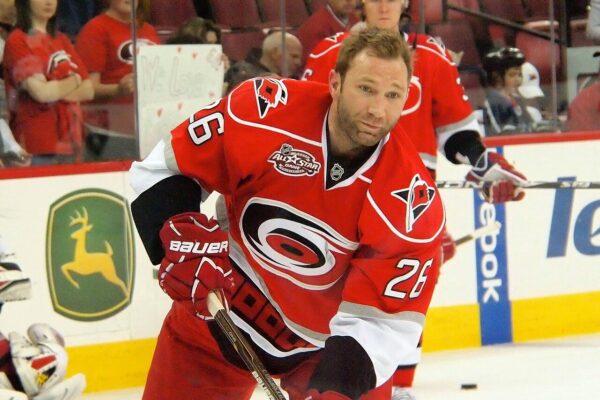
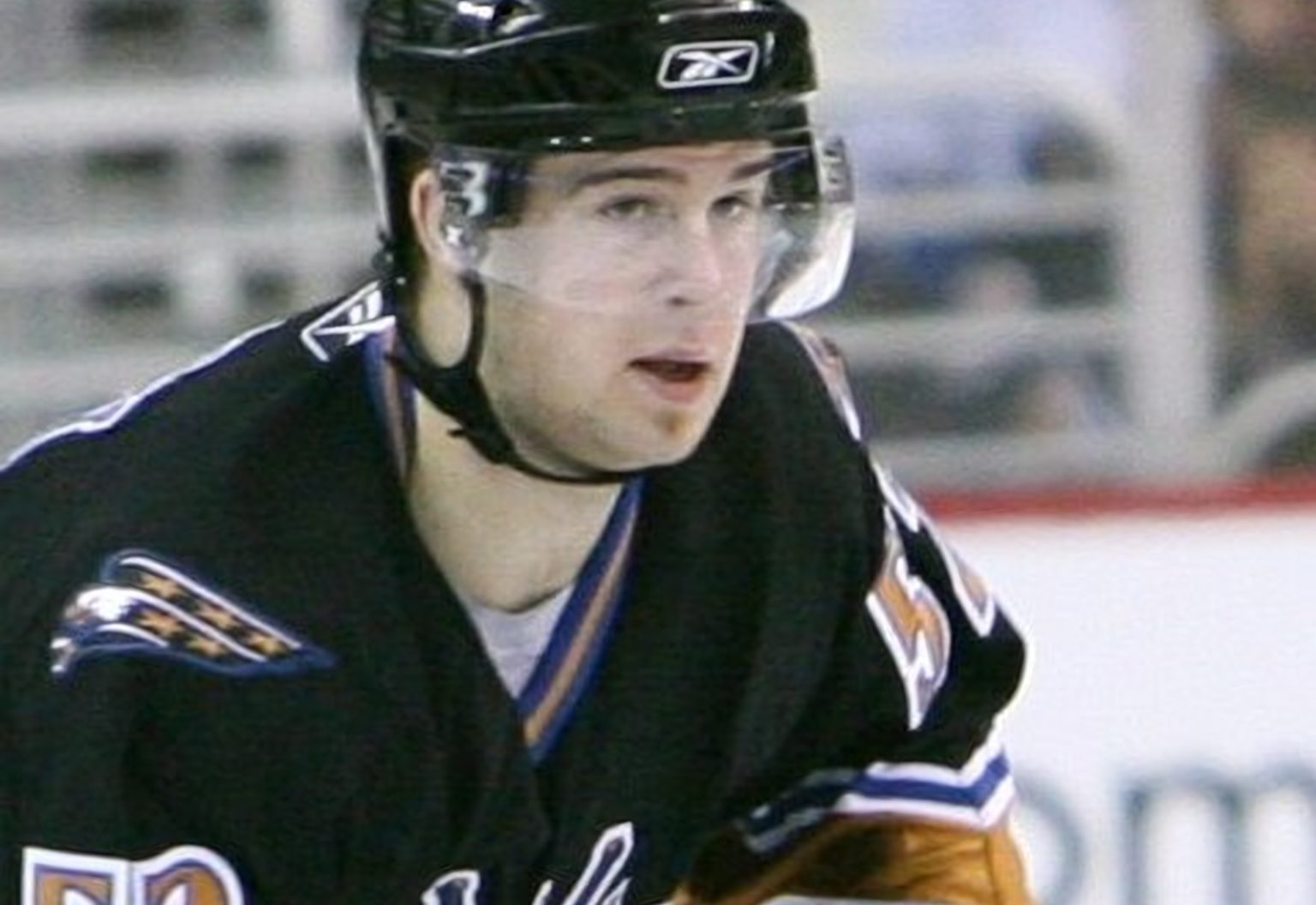
Thirty-one goals in 68 games: Mike Green’s 2008-09 season looked more like the work of a scoring winger than a defenseman. From Washington’s blue line, he found shooting lanes, slipped into open ice and finished chances himself. He became the first NHL defenseman to reach 30 goals in a season since Kevin Hatcher in 1992-93.
That year defined his reputation, but his career stretched well beyond it: a Calder Cup in Hershey, two Norris Trophy nominations, a second chapter in Detroit and a brief final stop in Edmonton. He retired in 2020 with 150 goals and 501 points in 880 NHL regular-season games.
Calgary beginnings and the road to Saskatoon
Michael David Green was born in Calgary, Alberta, on October 12, 1985. By his own account, he started playing hockey at nine because his friends were involved. The attraction was company before competition.
Playing minor hockey with Calgary’s NASA Hockey Association, he was hardly a finished product. Green later recalled struggling to skate backward and stop-awkward beginnings for someone who would make his living carrying the puck out of trouble.
His development took him to the Saskatoon Blades, where he appeared in Western Hockey League games across five seasons, from 2000-01 through 2004-05. The right-shot defenseman grew into a player trusted to generate offense as well as handle his own end.
Washington selected him 29th overall in the first round of the 2004 NHL Entry Draft. He returned to Saskatoon for another season and earned WHL East First All-Star Team honors in 2005 before turning professional.
Learning the professional game in Hershey
Green’s first two professional seasons involved travel between Washington and its American Hockey League affiliate, the Hershey Bears. The NHL opportunity was there, but so was time to develop in a winning minor-league team.
He helped Hershey win the Calder Cup in 2006. Across his AHL regular-season appearances from 2005 to 2007, he recorded 12 goals and 39 assists in 68 games.
His offensive instincts were already evident. Rather than treating the blue line as a boundary, he saw opportunities to move beyond it. The challenge was learning when those openings justified the risk.
By 2007-08, he was a regular in Washington and scored 18 goals in 82 games. With Alex Ovechkin, Nicklas Backstrom and Alexander Semin among the Capitals’ attacking options, Green gave the team another threat arriving from deeper positions.
On July 1, 2008, Washington signed him to a four-year, $21 million contract. His next season made that investment look well timed.
Mike Green’s 31-goal breakthrough
In 2008-09, Green produced 31 goals and 42 assists for 73 points despite playing only 68 games. He led NHL defensemen in both goals and points.
The season’s defining run ended on February 14, 2009, when he extended his goal-scoring streak to eight consecutive games against Tampa Bay. It established an NHL record for a defenseman.
There was more to his scoring than a heavy slapshot. He could carry the puck through the neutral zone, move into space while opponents tracked Washington’s forwards, and release a shot before the defense reset. On the power play, he was both distributor and finisher.
The nickname “Game Over Green” suited his knack for decisive goals, particularly late in games and in overtime.
He finished second in Norris Trophy voting in 2009, then returned as a finalist in 2010 after recording a career-high 76 points: 19 goals and 57 assists in 75 games. He earned NHL First All-Star Team honors in both seasons and appeared in the 2011 NHL All-Star Game.
International recognition came during the same rise. At the 2008 IIHF World Championship, he helped Canada win silver and earned a place on the tournament’s All-Star Team.
Injuries change the Washington years
The pace became harder to sustain as injuries interrupted his availability. Concussion problems and other injuries restricted Green to 49 games in 2010-11 and just 32 in 2011-12.
For a defenseman whose game depended on skating, timing and the confidence to join an attack, those absences mattered beyond the missing statistics. His seasons no longer had the continuity of his breakthrough years.
Washington nevertheless re-signed him on July 16, 2012, to a three-year, $18.25 million contract. He remained a productive offensive defenseman, though his role and minutes evolved.
His Capitals tenure ended in 2015 after 575 regular-season games. He left with 113 goals, 247 assists and 360 points for Washington-the largest share of his career production and the setting for his most distinctive hockey.
A new role in Detroit
On July 1, 2015, Green signed a three-year, $18 million contract with the Detroit Red Wings. After a decade in the Capitals organization, he was starting again in a different dressing room.
His scoring touch had not disappeared. On October 17, 2016, he scored all three of Detroit’s goals in a 5-1 victory over the Ottawa Senators? No: he supplied a hat trick in that 5-1 win, the first and only three-goal game of his NHL career.
He represented Detroit at the 2018 NHL All-Star Game, but neck trouble ended his season early. The Red Wings retained him on a two-year, $10.75 million contract signed on June 30, 2018.
Illness brought another disruption. A virus affected his availability during 2018-19, and Detroit shut him down for the remainder of the season in March.
Across five seasons with the Red Wings, Green played 303 regular-season games, scoring 37 goals and adding 104 assists for 141 points. His production no longer resembled his Washington peak, but he remained a useful puck-moving presence on the blue line.
Two games in Edmonton, then retirement
Edmonton acquired Green on February 24, 2020, giving him a late-career move back to Alberta. It proved a very short stay.
A sprained medial collateral ligament limited him to two appearances for the Oilers. He recorded no points before the NHL season was paused because of the COVID-19 pandemic.
When the league prepared to resume play, Green opted out, citing family reasons. He announced his retirement on August 26, 2020.
His final NHL totals were 880 games, 150 goals, 351 assists and 501 points. He never won the Stanley Cup, although his professional career included that Calder Cup championship with Hershey.
The player-and the person away from the rink
At his best, Green made opponents account for a fourth attacker without Washington having to change personnel. Listed at 6 feet 1 inch and around 210 pounds, he combined mobility with a powerful right-handed shot.
His aggressive positioning could leave space behind him. That was the balance in his game: the same willingness to push forward that created goals also demanded sound decisions and support from teammates.
Away from hockey, he described himself in an interview with The Athletic through his family roles: husband, father, son, brother and uncle. His decision to skip the NHL’s return-to-play tournament gave those priorities a public consequence. Beyond the family reasons he stated, there is no need to speculate about that choice.
His lighter observations offered another view of life in the league. Asked about teammates, he singled out Ovechkin as the funniest, describing the Washington captain’s personality as “wild” and “crazy.”
He was less enthusiastic about the Florida Panthers’ arena, criticizing its atmosphere, lighting and ice. It was a practical player’s assessment: beneath the television presentation, the workplace still came down to how a rink felt under the skates.
FAQ
Which NHL teams did Mike Green play for?
He played for the Washington Capitals, Detroit Red Wings and Edmonton Oilers. He also won the 2006 Calder Cup with the AHL’s Hershey Bears.
What were his career NHL statistics?
He finished with 150 goals and 351 assists for 501 points in 880 regular-season games.
What record did he set?
In February 2009, he became the first NHL defenseman to score in eight consecutive games.
Did he win the Norris Trophy?
No. He was a finalist in 2009 and 2010 and earned NHL First All-Star Team honors in both years.
Did he win a Stanley Cup?
No. His championship at the professional level was the Calder Cup with Hershey.
When did Mike Green retire?
He announced his retirement on August 26, 2020, after opting out of the NHL’s pandemic return-to-play program.
Photo: Keith Allison from Hanover, MD, USA, CC BY-SA 2.0, via Wikimedia Commons