Four games into his draft season, Rasmus Dahlin already looked like he belonged somewhere else. Not because he was too good for junior hockey, but because he was already skating SHL shifts for Frölunda as a teenager, carrying the puck with the calm of an older pro and drawing the kind of attention usually reserved for top-line scorers.
From Trollhättan to Frölunda
Dahlin was born on April 13, 2000, in Trollhättan, Sweden, and came through the Swedish development system in a hurry. He played youth hockey with HC Lidköping before moving into Frölunda’s pipeline, a step that put him on one of the country’s clearest tracks to elite-level hockey.
By the time he reached Frölunda’s junior teams, the rise had picked up speed. He was not just another promising defenseman in the system. Coaches and scouts saw a left-shot blueliner who could escape pressure, lead a rush himself and still recover quickly enough to defend the next play.
That promise turned into senior hockey early. Dahlin debuted in the SHL with Frölunda during the 2016-17 season and played 26 regular-season games, finishing with 1 goal and 3 points. Frölunda also won the Champions Hockey League that season, giving him a taste of high-level club success before he was old enough to be drafted.
The bigger offensive jump came the following year. In 2017-18, he played 41 SHL games and put up 7 goals and 20 points, rare production for a draft-eligible defenseman in Sweden’s top league. He was named Swedish Junior Hockey Player of the Year, and by then the conversation around him had become impossible to miss. He was widely viewed as the top prospect in the 2018 NHL Draft, not simply because of points, but because of how he played: upright posture, smooth edges, patience under pressure, and the confidence to hold the puck an extra second until the ice opened.
First overall, and straight into Buffalo
The Buffalo Sabres selected Dahlin first overall in 2018, making him the first Swedish-born player taken No. 1 since Mats Sundin in 1989. That was the headline. The harder part came next: stepping into the NHL with the weight that follows a first pick, especially one projected as a franchise defenseman.
He signed his entry-level contract with Buffalo on July 9, 2018, and went directly into the lineup. There was no long apprenticeship. As a rookie in 2018-19, he played all 82 games and finished with 9 goals and 44 points, including 35 assists. For a teenage defenseman adjusting to NHL pace and responsibility, those were strong numbers, and they earned him a place among the Calder Trophy finalists. He finished third in the voting.
The early years in Buffalo were not always smooth, and neither were the team results. But even when the Sabres were uneven, Dahlin’s role was obvious. The puck kept finding him. So did the toughest minutes. His game was built around movement more than force: quick feet in transition, shoulder checks before retrievals, and the ability to turn a defensive-zone touch into controlled offense.
Growing into the Sabres’ centerpiece
There is a difference between arriving with expectations and becoming the player a team runs through. Dahlin crossed that line over his first few seasons in Buffalo.
In September 2021, he signed a three-year, $18 million contract, a bridge deal that reflected both his importance and the sense that there was still another level coming. It arrived soon after. During the 2022-23 season, he posted 15 goals and 73 points in 78 games, the first point-per-game pace of his NHL career, and established himself among the league’s most productive defensemen.
That season also included a quirky record: he scored in each of Buffalo’s first four games, the longest season-opening goal streak ever by an NHL defenseman. It was a small snapshot of a larger trend. He was no longer just creating offense from the back end; he was dictating it.
Buffalo doubled down on that status in October 2023, signing him to an eight-year, $88 million extension with an $11 million average annual value. The deal runs through the 2031-32 season and made clear how the organization viewed him: not as a supporting piece, but as a pillar.
The leadership title followed. On September 26, 2024, the Sabres named Dahlin captain, making him the 21st captain in franchise history and the first defenseman to wear the “C” for Buffalo since Craig Rivet. By then, the progression made sense. He had entered the league as a gifted young defenseman. He had become the player teammates looked to for minutes, puck touches and tone.
What makes Rasmus Dahlin so effective
Some defensemen pile up points by staying high in the zone and waiting for touches. Dahlin’s offense starts earlier than that.
His skating is the foundation. He covers ground quickly, but more importantly, he changes direction without losing control of the puck. That lets him beat the first forechecker, carry through the neutral zone and force defenders to back off. Once he has that space, he can either distribute or keep moving until a lane opens.
He is also more than an attacking blueliner. At his best, Dahlin plays with enough poise to slow the game down. He can hold the line in the offensive zone, reset a possession, or absorb pressure and make the simple play instead of the flashy one. That balance is why he has long been described as a two-way defenseman, even if the offense tends to draw the first attention.
His NHL All-Star selections in 2022, 2023 and 2024 reflected that rise from top prospect to established star. So did the Norris Trophy conversation that followed as his minutes, usage and production kept climbing.
Sweden came early too
Long before he had a full NHL résumé, Dahlin was already a regular in Swedish national-team discussions. He played at the World Junior Championship in 2017 and 2018, and in between those tournaments he made Sweden’s Olympic team for the 2018 Winter Games in PyeongChang.
That Olympic appearance stood out for one simple reason: age. Dahlin was the youngest player in the men’s tournament, a rare distinction in an event usually dominated by older professionals.
At the 2018 World Juniors, Sweden won silver. The tournament is also remembered for the medal-ceremony incident in which Dahlin removed his silver medal shortly after receiving it. The IIHF later suspended him for Sweden’s first two games of the 2019 World Junior Championship. It became an early lesson in how quickly a visible moment can follow a young player.
His senior international career has included appearances at the IIHF World Championship, and he was part of the Sweden team that won bronze in 2024. He also represented his country at the NHL’s 4 Nations Face-Off, another sign of how firmly he had moved from prodigy to fixture.
The captaincy and the pressure that comes with it
For much of his career, the story around Dahlin has included expectation almost as much as performance. That started in Sweden, intensified before the draft, and never really left.
In Buffalo, those expectations were not abstract. He was asked to be the defenseman who could break the puck out cleanly, run the power play, handle top competition and represent the direction of the franchise. Later, he was asked to wear the captain’s “C” as well.
That combination says as much about trust as talent. Defensemen are often judged in layers: points, minutes, matchups, mistakes, recoveries. Dahlin’s game has always invited close watching because there is so much of it. He is involved in transition, in possession, in attack and in retrievals. When Buffalo is moving well, his fingerprints are usually on the sequence.
Off the ice: what is public, and what is not
Publicly documented details about Dahlin away from hockey are fairly limited, which is often the case with players who keep a low profile off the ice.
What is known is that hockey runs in the family. His father, Martin Dahlin, also played the sport, and Rasmus has spoken at different points about growing up in a hockey environment in Sweden. Beyond that, most of the available picture comes through moments rather than long interviews or a heavily public personal brand.
One of those moments came during his international career, with the medal-removal incident after the 2018 World Juniors. Another came later in Buffalo, when his visible frustration during difficult stretches underscored how seriously he takes standards and results. That is not rumor; it is part of the public record of how he carries himself as a player and leader.
As for private life, there is little that should be stated beyond what has been clearly reported. He has generally kept that side of his life out of the spotlight, and there is no need to fill the gaps with speculation.
The shape of his career so far
Dahlin’s path has been unusually direct. He was a standout in Sweden, a first overall pick in the 2018 NHL Draft, an immediate NHL regular, an All-Star, and eventually the captain of the Buffalo Sabres. The details matter, but so does the pattern. At nearly every stage, he has been moved forward quickly because coaches believed he could handle more.
That trust has followed him from Frölunda to Buffalo and from junior tournaments to Sweden’s senior team. It is the through line of his career: not just talent, but responsibility.
FAQ
Is Rasmus Dahlin the captain of the Sabres?
Yes. The Buffalo Sabres named Rasmus Dahlin captain on September 26, 2024.
When was Rasmus Dahlin drafted?
He was selected first overall by Buffalo in the 2018 NHL Draft.
What is Rasmus Dahlin’s contract?
He signed an eight-year, $88 million extension with the Sabres on October 9, 2023. The deal carries an $11 million cap hit.
Has Rasmus Dahlin won medals with Sweden?
Yes. He won silver at the 2018 World Junior Championship and bronze at the 2024 IIHF World Championship.
What kind of player is Rasmus Dahlin?
He is a left-shot defenseman known for elite skating, puck control, transition play and strong offensive involvement from the blue line.
How many NHL All-Star Games has he made?
He was selected to the NHL All-Star Game three times: 2022, 2023 and 2024.
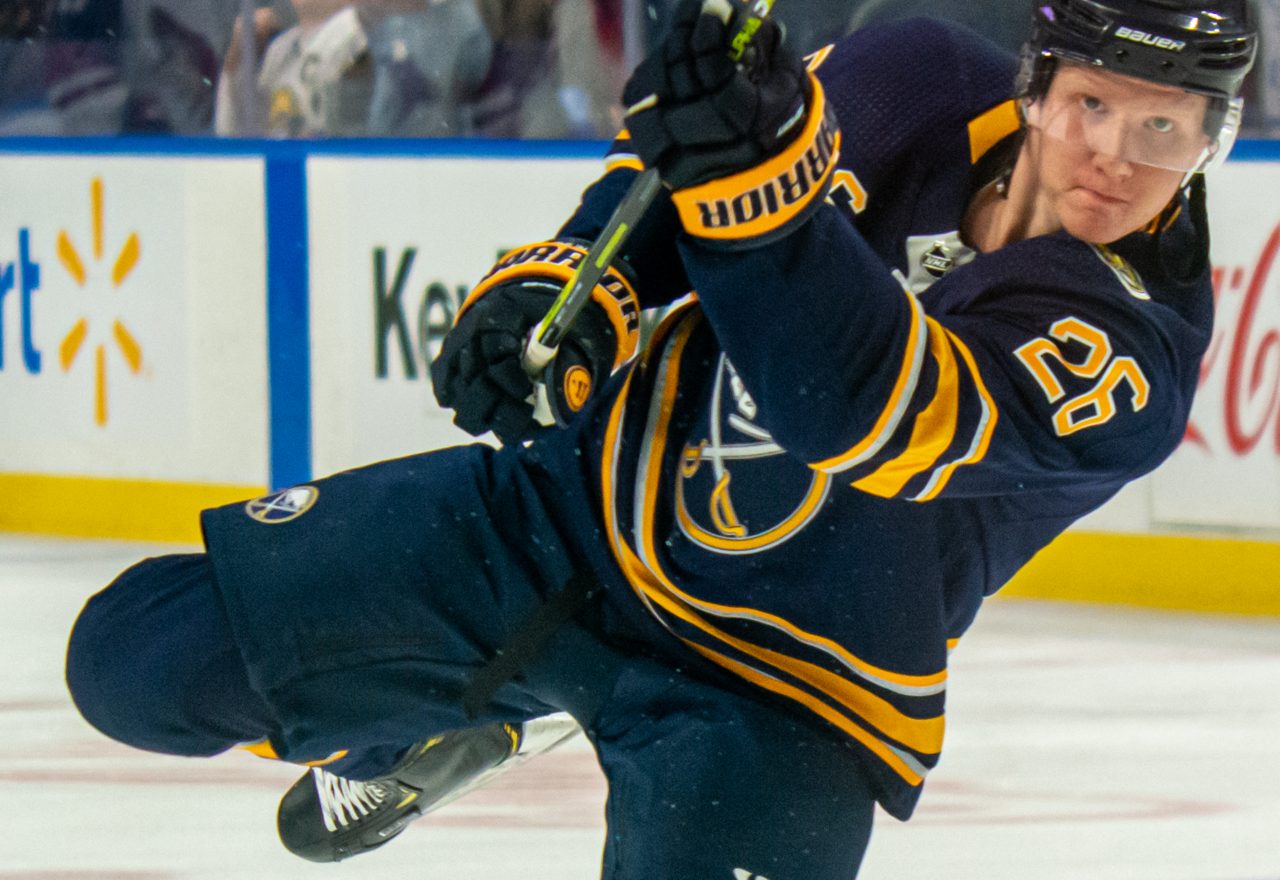
Photo: Colin Gallagher, CC BY-SA 4.0, via Wikimedia Commons